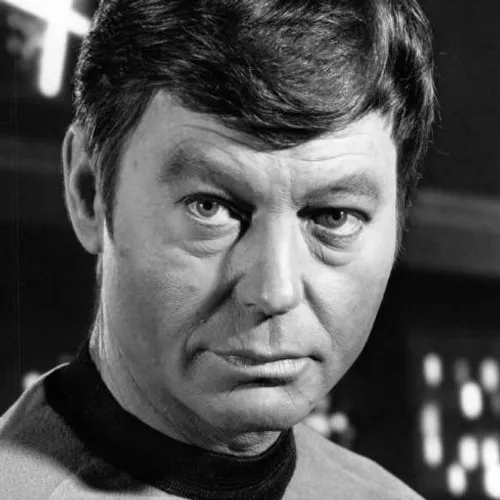
DeForest Kelley
An American actor, screenwriter, poet and singer known for his iconic roles in Westerns and as Dr. Leonard "Bones" McCoy of the USS Enterprise in the television and film series Star Trek.
DeForest Kelley's journey through the entertainment world began long before he became the iconic Dr. Leonard McCoy of Star Trek. His early forays into broadcasting and performance would ultimately set the stage for a remarkable career that would capture the imagination of millions.
Early Life and Musical Beginnings
Born on January 20, 1920, in Atlanta, Georgia, Jackson DeForest Kelley was the son of a Baptist minister with Irish ancestry. From a young age, Kelley demonstrated a remarkable musical talent that would become his first professional outlet. In his early years, he regularly sang solo during morning church services, showcasing a vocal prowess that would soon extend beyond the church walls. Despite his family's limited financial resources preventing him from pursuing a medical career like his uncle, Kelley found alternative paths to performance. He began singing on local radio shows in Atlanta, including a notable appearance that caught the attention of Lou Forbes and his orchestra. This early radio work demonstrated Kelley's natural performance abilities and set the stage for his future entertainment career.
Radio and Early Performance Career
Kelley's radio experience was more than just a passing interest. He actively pursued opportunities in local broadcasting, using his musical talents to gain exposure. His radio work was so promising that it led to performance engagements and helped him develop the communication skills that would later define his acting career. In 1957, Kelley even appeared in a radio drama episode of a program called Suspense, specifically in an episode entitled "Flesh Peddler". A producer at the time introduced him as "a bright new luminary in the Hollywood firmament", recognizing his potential beyond traditional radio performance.
Transition to Screen and Television
While radio was an important early medium for Kelley, he quickly transitioned to film and television. His acting career began in 1940, and he served in the military from 1943 to 1946. After his service, he permanently relocated to Southern California, determined to pursue acting professionally. Kelley's early career was characterized by versatility. He appeared in numerous television shows, often playing villainous roles. For nine years, he primarily portrayed antagonists, building an extensive list of credits across television and motion pictures.
Star Trek and Lasting Legacy
The role that would define Kelley's career came in 1966 when he was cast as Dr. Leonard "Bones" McCoy in Star Trek. Gene Roddenberry had actually offered him the role in 1964, which Kelley initially refused. He would go on to play McCoy in the original television series, animated series, and the first six Star Trek motion pictures. Interestingly, Kelley took pride in McCoy's legacy, stating that his character had inspired many people to become doctors. In a poignant reflection, he noted, "That's something that very few people can say they've done. I'm proud to say that I have".
Personal Life and Final Years
Married to Carolyn Charlotte Meagher Dowling for nearly 55 years, Kelley was known for his loving relationship. The couple, who had no children, lived in a humble ranch house in California. Colleagues described them as "the most loving couple you've ever seen in your life". Kelley was diagnosed with stomach cancer in 1997 and passed away on June 11, 1999, at the age of 79. His remains were cremated, and his ashes were spread over the Pacific Ocean.
Works and Appearances
Radio
- Suspense - "Flesh Peddler" episode (1957)
Television
- Star Trek: The Original Series (1966-1969) - Dr. Leonard McCoy
- Star Trek: The Animated Series (1973-1974) - Voice of Dr. McCoy
- Star Trek: The Next Generation - "Encounter at Farpoint" (1987) - Admiral McCoy
Film
- First six Star Trek motion pictures (1979-1991)
- Various Western and drama films (1940-1991)
DeForest Kelley's journey from radio performer to television icon represents a remarkable trajectory in 20th-century entertainment, bridging multiple media and capturing the hearts of generations.
