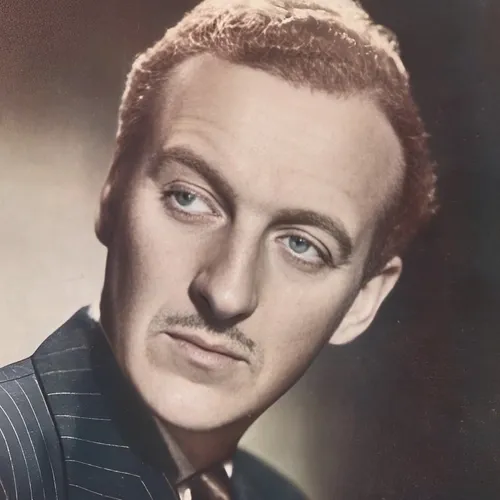
David Niven
An English actor and novelist, popular both in Europe and the US.
David Niven was a multifaceted entertainer whose contributions to entertainment extended far beyond his celebrated film career, including significant work in radio broadcasting during World War II. A charismatic actor, soldier, and broadcaster, Niven's wartime radio efforts were as remarkable as his Hollywood achievements.
Early Life and Military Background
Born James David Graham Niven on March 1, 1910, in London, England, Niven came from an upper-middle-class background. After attending Heatherdown Preparatory School and Stowe School, he was commissioned at the Royal Military College, Sandhurst, launching his initial career in the British Army.
Niven's military service was distinguished, spanning two significant periods: 1930-1933 and 1940-1945. During World War II, he served with the Highland Light Infantry and Rifle Brigade, ultimately rising to the rank of Lieutenant Colonel. His wartime experiences would prove instrumental in his later radio broadcasting efforts.
Radio Broadcasting and Entertainment for Troops
During World War II, Niven played a crucial role in military entertainment broadcasting. In 1944, he worked extensively with military radio efforts designed to provide entertainment to British, Canadian, and American forces in England and Europe. He collaborated closely with SHAEF (Supreme Headquarters Allied Expeditionary Force) to expand broadcast efforts.
One of his most notable contributions was working with Major Glenn Miller's band, helping to facilitate the band's performances and broadcasts for troops. Niven was instrumental in the operation to move Miller's band to France, just before Miller's tragic disappearance over the English Channel.
Wartime Radio and Morale Boosting
Niven's radio work wasn't just administrative; he was known for his wit and ability to boost troop morale. During the war, he became famous for his humorous interactions that demonstrated remarkable composure. When suspicious American sentries asked who won the World Series, he cleverly responded, "Haven't the foggiest idea, but I did co-star with Ginger Rogers in Bachelor Mother!"
His contributions were recognized with the Legion of Merit, an American military decoration honoring his work in setting up radio news and entertainment stations for Allied forces.
Post-War Broadcasting and Media Transition
After the war, Niven's entertainment career flourished across multiple media. While primarily known as a film actor, he continued to be involved in broadcasting. In 1959, he hosted his own TV drama series, and in 1972, he hosted David Niven's World, a program profiling contemporary adventurers that ran for 21 episodes.
Legacy and Impact
David Niven's radio work during World War II represents a fascinating chapter in entertainment history. Beyond his Oscar-winning acting career, his wartime broadcasting efforts played a significant role in maintaining troop morale and providing crucial entertainment during a challenging period.
Works and Appearances
Radio
- Allied Forces Entertainment Broadcasts (1944-1945)
- David Niven's World (1972, TV series, 21 episodes)
Film
- Around the World in 80 Days (1956)
- Separate Tables (1958, Oscar-winning performance)
- The Pink Panther (1963)
Television
- Unnamed TV Drama Series (1959)
- David Niven's World (1972)
Books
- The Moon's a Balloon (Memoir)
- Bring on the Empty Horses (Memoir)
David Niven's multifaceted career demonstrates how entertainers during mid-20th century could seamlessly transition between military service, radio broadcasting, film, and television, leaving an indelible mark on popular culture.