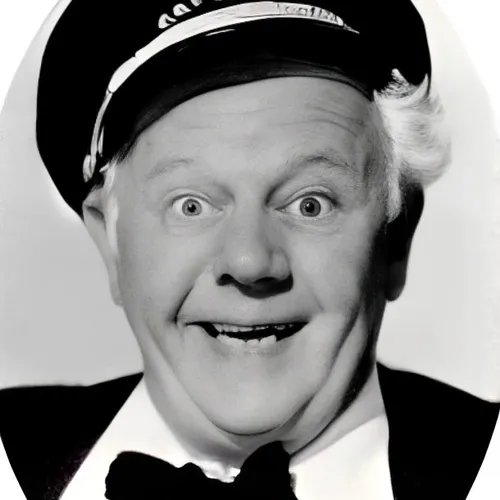
Charles Winninger
An American stage and film actor, most often cast in comedies or musicals, but equally at home in drama. Charles Winninger began as a vaudeville actor. His most famous stage role was as Cap'n Andy Hawks in the original production of the Jerome Kern - Oscar Hammerstein II musical classic Show Boat in 1927, a role that he reprised – to great acclaim – in the 1932 stage revival and the 1936 film version of the show.
Charles J. Winninger was a versatile American actor whose distinctive voice and charismatic performances made him a beloved figure in early radio broadcasting and entertainment. Best known for his iconic portrayal of riverboat captains, Winninger bridged the worlds of stage, radio, and screen during the golden age of American entertainment.
From Wisconsin Roots to Entertainment Stardom
Born on May 26, 1884, in Charles J. Winninger emerged from humble beginnings in Vienna, Wisconsin. The son of Austrian immigrants Rosalia and Franz Winninger, he began his entertainment career as a stage actor, gradually building a reputation for his warm, engaging performances. His early work in vaudeville and theater laid the foundation for what would become a remarkable career spanning multiple entertainment mediums. Winninger's breakthrough came with his most famous stage role as Cap'n Andy Hawks in the original production of Show Boat in 1927. This role would become so closely associated with him that he would reprise it multiple times, including in the 1932 stage revival and the 1936 film version. His portrayal of the jovial riverboat captain became a template that he would return to throughout his career, particularly in radio broadcasting.
The Radio Years: Mastering the Airwaves
Radio became Winninger's primary medium for connecting with audiences. His most notable radio work was on the Maxwell House Show Boat program, where he essentially recreated his Show Boat character for listeners across America. His warm, folksy delivery and ability to create vivid characters made him a favorite among radio audiences. Winninger's radio performances were characterized by their authenticity and charm. He brought a sense of genuine storytelling to his broadcasts, making listeners feel as though they were sitting on a riverboat, listening to tales spun by a wise and entertaining captain. His work on radio demonstrated his remarkable ability to use voice alone to create compelling narratives and memorable characters.
Expanding into Film and Television
While radio was his primary medium, Winninger was also a prolific film actor. He appeared in numerous movies throughout the 1930s and 1940s, often playing supporting roles that showcased his comedic timing and character acting skills. Notable films included Three Smart Girls, Night Nurse, and State Fair. In television, Winninger made a memorable appearance in 1954 on I Love Lucy, playing Barney Kurtz, the former vaudevillian partner of Fred Mertz in an episode titled "Mertz and Kurtz". This appearance demonstrated his ability to adapt to new entertainment technologies while maintaining his characteristic charm.
Legacy and Recognition
Charles Winninger's contributions to entertainment were significant and widely recognized. In 1960, he received a star on the Hollywood Walk of Fame for his radio contributions. His career spanned an impressive five decades, from 1910 to 1960, during which he became a beloved figure in American entertainment. Winninger passed away on January 27, 1969, in Palm Springs, California, leaving behind a rich legacy of performances that helped define the golden age of radio and early film. He was more than just an actor; he was a storyteller who could transport audiences through the power of his voice and personality.
Works and Appearances
Radio
- Maxwell House Show Boat (Primary radio program)
- Philip Morris Playouse - "Friendly Enemies" (1942)
Film
- Show Boat (1936) - Cap'n Andy Hawks
- Three Smart Girls (1936)
- Night Nurse (1931)
- State Fair (1945) - Abel Frake
- Those Were the Days (1953, TV Movie)
Television
- I Love Lucy - Barney Kurtz (1954)
Theater
- Show Boat (Original Production, 1927)
- Show Boat (Stage Revival, 1932)
- Music in the Air (Broadway Revival, 1951)