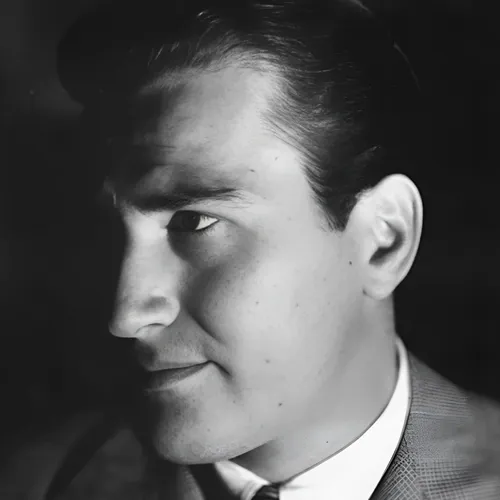
Artie Shaw
An American clarinetist, composer, and bandleader. Also an author, Shaw wrote both fiction and non-fiction.
Artie Shaw emerged as one of the most innovative and complex musical personalities of the swing era, a clarinetist whose brilliance extended far beyond the bandstand. More than just a musician, Shaw was a cultural icon who challenged musical conventions and resisted the commercial trappings of fame, making him a unique figure in mid-20th-century American entertainment.
The Making of a Musical Maverick
Born Arthur Jacob Arshawsky on May 23, 1910, in New York City, Shaw came from a Jewish immigrant family with roots in Russia and Austria. His musical journey began early, purchasing a saxophone while working at a grocery store and switching to clarinet at 16, a decision that would define his legendary career. Shaw's early professional years were marked by constant musical exploration. From 1925 to 1936, he performed with numerous bands and orchestras, establishing a reputation as an innovative arranger and musician. His natural talent and intellectual curiosity set him apart from contemporaries, as he continuously sought to push musical boundaries.
Radio and the Rise to Stardom
The late 1930s marked Shaw's breakthrough into national prominence. His radio performances became legendary, with broadcasts from venues like the Blue Room of the Hotel New Yorker capturing audiences nationwide. In 1938, his recording of "Begin the Beguine" catapulted him to superstardom, transforming him from a relatively unknown bandleader to a major pop artist. Shaw's radio work was revolutionary. He was not content with merely entertaining; he wanted to challenge musical norms. During his radio series with comedian Jimmy Durante, Shaw demonstrated his restless artistic spirit, often growing frustrated with repetitive performances. His famous quote encapsulated this sentiment: "I thought that because I was Artie Shaw I could do what I wanted, but all they wanted was 'Begin the Beguine'".
Breaking Barriers and Challenging Conventions
Beyond musical innovation, Shaw was socially progressive. In 1938, he became the first white bandleader to hire Billie Holiday as a full-time black female vocalist, a groundbreaking move in the racially segregated entertainment industry. His bands consistently featured exceptional musicians, and he was known for his experimental approach to orchestration. During World War II, Shaw's commitment extended beyond music. He enlisted in the Navy from 1942 to 1944, forming a band that performed in battle zones, sometimes giving up to four concerts daily. This period of service profoundly impacted him, leading to introspection and eventually a gradual withdrawal from professional music.
The Intellectual Musician
Shaw was far more than a mere entertainer. An intellectual with diverse interests, he was an accomplished writer who published an autobiography, The Trouble With Cinderella, and several works of fiction. His perfectionism and disdain for the commercial music business ultimately led him to retire from performing in 1954, leaving an indelible mark on American musical culture. In his later years, Shaw remained a respected figure. In 1983, at 73, he even organized a new band, selecting clarinetist Dick Johnson as bandleader, demonstrating his continued passion for musical excellence.
Legacy and Impact
Artie Shaw died on December 30, 2004, at 94, leaving behind a legacy as one of jazz's most innovative clarinetists. Widely regarded as the "King of the Clarinet," he consistently challenged musical and social conventions. His influence extended beyond his own performances, inspiring countless musicians and reshaping the landscape of American popular music.
Works and Appearances
Radio
- Various radio broadcasts (1938-1941)
- Burns and Allen Show (1940-1941)
Films
- Second Chorus (1940)
- Dancing Co-Ed (1939)
Music Recordings
- Notable hits: "Begin the Beguine" (1938)
- "Frenesi" (1940)
- "Summit Ridge Drive" (1941)
Books
- The Trouble With Cinderella (1952)
- I Love You, I Hate You, Drop Dead! (1965)
- The Best of Intentions and Other Stories (1989)
Artie Shaw's life was a testament to artistic integrity, intellectual curiosity, and an unwavering commitment to musical innovation.