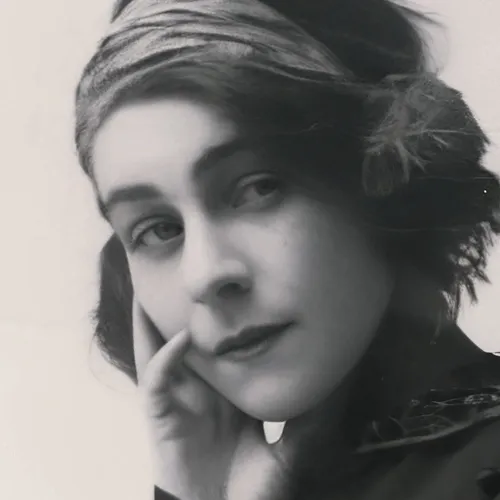
Alla Nazimova
Alla Nazimova (Russian and Ukrainian: Алла Назимова; 3 June 1879 – 13 July 1945) was an American film and theater actress, a screenwriter, and film producer. She is perhaps best known as simply Nazimova, but also went under the name Alia Nasimoff. She emigrated to the United States from the Russian Empire. She was influential in the film industry in the silent era and continued to play character roles till the end of her life.
Early life She was born Miriam Edez Adelaida Leventon, one of three children of Yakov Leventon and Sonya Horowitz. The family was Jewish and lived inYalta, Crimea (then a part of the Russian Empire; now a part of Ukraine). She grew up in a dysfunctional family and after her parents' separation was shuffled among boarding schools, foster homes, and relatives. A precocious child, she was playing the violin by age seven. As a teenager she began to pursue an interest in the theatre and took acting lessons at the Academy of Acting in Moscow before joining Constantin Stanislavski's Moscow Art Theatre as "Alla Nazimova," and later just "Nazimova." (Her stage name was a combination of her middle name Adelaida - shortened to Alla, usually a distinct Russian first name in its own right - and the surname of Nadezhda Nazimova, the heroine of the Russian novelChildren of the Streets. Career
Nazimova in the 1911 Broadway play The Marionettes
Nazimova's theater career blossomed early; and by 1903 she was a major star in Moscow and Saint Petersburg. She toured Europe, including London and Berlin, with her boyfriend Pavel Orlenev, a flamboyant actor and producer. In 1905 they moved to New York City and founded a Russian-language theater on the Lower East Side. The venture was unsuccessful; and Orlenev returned to Russia while Nazimova stayed in New York. She was signed up by the American producer Henry Miller and made her Broadway debut in New York City, in 1906 to critical and popular success. She quickly became extremely popular (a theater was named after her) and remained a major Broadway star for years, often acting in the plays of Henrik Ibsen and Anton Chekhov. Dorothy Parker described her as the finest Hedda Gabler she had ever seen. Due to her notoriety in a 35-minute 1915 play entitled War Brides, Nazimova made her silent film debut in 1916 in the filmed version of the play. A young actor with a bit part in the movie was Richard Barthelmess whose mother taught Nazimova English. This appearance brought her to the attention of Lewis J. Selznick. Over the next few years she made a number of highly successful films that earned her a considerable amount of money. By 1917 her contract was earning her $13,000 per week. In 1918, Nazimova felt confident enough in her abilities to begin producing and writing films in which she also starred. In her film adaptations of works by such notable writers as Oscar Wilde and Ibsen she developed her own film making techniques, which were considered daring at the time. Her projects, including A Doll's House (1922), based on Ibsen, and Salomé (1923), based on Wilde's play, were critical and commercial failures. By 1925 Nazimova could no longer afford to invest in more films; and financial backers withdrew their support. Left with few options, she gave up on the film industry, returning to perform on Broadway, notably starring as Natalya Petrovna in Rouben Mamoulian's 1930 New York production of Turgenev's A Month in the Country and an acclaimed performance as Mrs. Alving in Ibsen's Ghosts. In the early 1940s, she appeared in a few more films, playing Robert Taylor's mother in Escape (1940) and Tyrone Power's mother in Blood and Sand (1941). This late return to motion pictures fortunately preserves Nazimova and her art on sound film. Private life
This 1921 Vanity Fair caricature by Ralph Bartonshows the famous people who, he imagined, left work each day in Hollywood; use cursor to identify individual figures.
Marriages and children In 1899 she married Sergei Golovin, a fellow actor. However, the marriage was "in name only"; and the two never legally divorced. While still in Russia and before coming to America in 1905, Nazimova may have given birth to a child. The father has been speculated to be either her husband Golovin or her lover Orlenev. From 1912 to 1925 Nazimova lived in a "lavender marriage" with Charles Bryant (1879–1948), a New York actor. Relationships with women Between the years of 1917 and 1922 Nazimova wielded considerable influence and power in Hollywood. By all accounts she was extremely generous to young actresses in whom she saw talent and became involved with at least some of them romantically. For instance, after meeting a young Patsy Ruth Miller at a Hollywood party, Nazimova assisted in getting Miller's career launched. (Miller got her first break with a small role in Camille.) Another noteworthy example was Anna May Wong, whose first film role at age 14 was as an extra in The Red Lantern. Nazimova helped start the careers of both of Rudolph Valentino's wives, Jean Acker and Natacha Rambova. Although she was involved in an affair with Acker, it is debated as to whether her connection with Rambova ever developed into a sexual affair. Nevertheless, there were rumors that Nazimova and Rambova were involved in a lesbian affair (they are discussed at length in Dark Lover, Emily Leider's biography of Rudolph Valentino) but those rumors have never been definitely confirmed. She was very impressed by Rambova's skills as an art director; and Rambova designed the innovative sets for Nazimova's film productions of Camille and Salomé. Of those Nazimova is confirmed to have been involved with romantically, the list includes actress Eva Le Gallienne, director Dorothy Arzner, writer Mercedes de Acosta, and Oscar Wilde's niece, Dolly Wilde. Bridget Bate Tichenor, a Magic Realist artist and Surrealistpainter, was also rumored to be one of Nazimova's favored lovers in Hollywood during the World War II years of 1940 to 1942. The two had been introduced by the poet and art collector Edward James, and according to Tichenor, their intimate relationship angered Nazimova's longtime companion, Glesca Marshall. It is allegedly Nazimova who coined the phrase "Sewing circles" as code to refer to lesbian or bisexual actresses of her day who concealed their true sexuality. Nazimova lived with Glesca Marshall from 1929 until her death in 1945. Life in the United States
Alla Nazimova with Herbert Brenon, 9 Augu