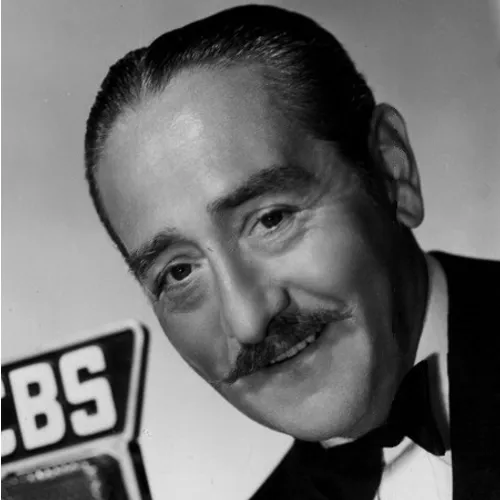
Adolphe Menjou was a quintessential Hollywood personality whose sophisticated persona transcended film and radio, making him a notable figure in early 20th-century entertainment. Known for his impeccable style and distinctive mustache, Menjou navigated multiple media platforms with remarkable versatility, leaving an indelible mark on American popular culture.
Early Life and Hollywood Beginnings
Born on February 18, 1890, in Pittsburgh, Pennsylvania, Adolphe Jean Menjou came from a diverse background. His father was French, and his mother was Irish, with a fascinating family connection to the renowned writer James Joyce. Menjou's early education took him to Cornell University, where he earned an engineering degree, though his true passion lay in performance. Menjou's entry into entertainment was not immediate. After graduating, he was drawn to the stage and made his movie debut in 1916. His breakthrough came during World War I, where he served as a captain in the military, an experience that would later inform his professional versatility.
Rise to Stardom in Film and Radio
By the 1920s, Menjou had established himself as a prominent Hollywood actor. His sophisticated on-screen presence and impeccable fashion sense earned him the title of Best Dressed Man in America nine times. He became known for his ability to portray both lovers and villains with equal finesse. His radio career paralleled his film success, with appearances on notable programs like Screen Guild Players and This Is Hollywood. Menjou's distinctive voice and urbane personality made him a natural fit for radio entertainment.
Political Activism and Hollywood Controversies
Menjou was not just an entertainer but a vocal political figure. A staunch Republican, he was known for his right-wing political stances and involvement with the House Un-American Activities Committee (HUAC). His political views often put him at odds with fellow Hollywood personalities, most notably Katharine Hepburn, with whom he had public disagreements. His political activism extended to testifying about communist influences in Hollywood, a controversial stance that defined much of his later career. Despite the potential professional risks, Menjou remained unapologetically outspoken about his beliefs.
Later Career and Legacy
As Hollywood evolved, so did Menjou's career. While his leading roles diminished, he continued to work steadily in supporting roles throughout the 1940s and 1950s. His final film appearance was in Disney's Pollyanna in 1960, capping off a remarkable four-decade career. Menjou received a star on the Hollywood Walk of Fame in 1960, cementing his place in entertainment history. His legacy extends beyond his performances, as his distinctive mustache style became so iconic that in Germany, a particular type of mustache is still called a "Menjou-Bärtchen".
Personal Life and Final Years
Married three times, Menjou's personal life was as dynamic as his professional one. His third marriage to actress Verree Teasdale lasted until his death. They adopted a son, Peter Menjou. An avid golfer, Menjou published his autobiography, It Took Nine Tailors, in 1948. On October 29, 1963, Menjou passed away in Beverly Hills, California, leaving behind a complex legacy as an actor, political commentator, and cultural icon.
Works and Appearances
Radio:
- Screen Guild Players (1946)
- This Is Hollywood (1946)
Film (Selected Highlights):
- A Woman of Paris (1923)
- The Front Page (1931)
- A Star Is Born (1937)
- Paths of Glory (1957)
- Pollyanna (1960)
Television:
- Various guest appearances in the 1950s, including episodes of anthology series
Adolphe Menjou's multifaceted career exemplifies the dynamic nature of mid-20th-century entertainment, bridging film, radio, and political discourse with remarkable panache.