Will Rogers
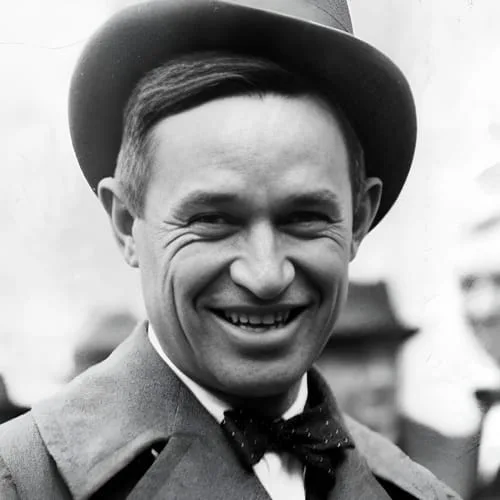
Will Rogers was one of the most beloved American entertainers of the early 20th century, known for his humor, social commentary, and versatile presence across stage, film, and radio. Celebrated as a humorist, actor, and political commentator, Rogers bridged entertainment and public discourse, endearing himself to millions with his homespun wisdom and sharp wit. His career, which spanned vaudeville, Broadway, motion pictures, and radio, made him an iconic figure in American culture.
Early Life and Background
William Penn Adair Rogers was born on November 4, 1879, in Carthage, Indian Territory (present-day Oklahoma), into a prominent Cherokee family. His father, Clement Vann Rogers, was a Cherokee senator and rancher, while his mother, Mary America Schrimsher, supported the family and its cultural heritage. Growing up in this environment, Rogers developed a deep connection to both Cherokee traditions and frontier life, experiences that shaped his later humor and worldview. Rogers showed an early interest in entertainment and horsemanship. His skills as a horseman were widely recognized, leading him to perform in Wild West shows, which combined his equestrian talent with his natural comedic timing. This early exposure to performance laid the foundation for a career that would later encompass vaudeville, stage acting, and ultimately radio and film.
Entry into Entertainment and Radio
Rogers’ entertainment career began in the early 1900s with Wild West shows and vaudeville performances. He soon became famous for his rope tricks, riding prowess, and sharp humor, which relied on observational wit and social commentary rather than slapstick. His ability to engage audiences with intelligent humor distinguished him from many contemporaries in the vaudeville circuit. By the 1920s and 1930s, Rogers had expanded into radio, using the medium to reach audiences across the United States. On radio, he became a regular commentator, delivering humorous reflections on politics, society, and everyday life. His charm lay in making complex social and political issues accessible and entertaining to listeners, often prefacing commentary with his signature wit, such as, “I never met a man I didn’t like.” This approach solidified his reputation as both a humorist and a trusted voice on public affairs. Rogers’ radio appearances coincided with a national appetite for personable, relatable entertainers who could connect with audiences during the challenging years of the Great Depression. His folksy delivery, combined with keen insight, made his broadcasts widely popular, turning him into a household name.
Film Career and Public Persona
Parallel to his radio work, Rogers became a major figure in motion pictures. Beginning in the 1910s, he appeared in silent films, showcasing his horsemanship and comedic timing. With the advent of sound films, Rogers seamlessly transitioned into “talkies,” where his natural voice and humor further endeared him to audiences. He appeared in a total of 71 films, often portraying characters who reflected his own persona: witty, wise, and grounded in common sense. Rogers’ film roles often mirrored his public persona—a charming, everyman figure capable of both comedy and subtle social critique. His on-screen performances complemented his radio work, reinforcing his image as an approachable and insightful commentator on American life. Collaborating with studios such as Fox Film Corporation and Paramount Pictures, Rogers helped define the early American comedic film genre while maintaining authenticity in his performances.
Political Commentary and Broadcasting Style
One of Rogers’ defining contributions to American media was his ability to combine humor with political commentary. On both radio and in print, he addressed contemporary issues with clever aphorisms and homespun observations. Unlike other entertainers of his era, Rogers refrained from mean-spirited humor, instead offering critiques that were insightful, witty, and accessible to a broad audience. Rogers’ broadcasting style relied on conversational delivery, often speaking directly to listeners as if engaging in a personal conversation. He drew upon everyday experiences and historical knowledge to craft commentary that was both educational and entertaining. His distinct voice and rhythm, along with his signature humor, made him a natural fit for radio, where tone and timing were crucial. These broadcasts helped cement his legacy as one of the first mass-media humorists to reach national prominence. In addition to radio, Rogers contributed to newspapers and magazines, writing columns that echoed the same witty observations delivered over the airwaves. This multi-platform presence allowed him to reach a wide audience, furthering his influence on American culture and public discourse.
Legacy and Personal Life
Rogers’ career was tragically cut short by his death in a plane crash on August 15, 1935, during a goodwill flight in Alaska. Despite his untimely death, his legacy endured through his films, radio broadcasts, and writings, influencing generations of entertainers and commentators. His approach to humor—intelligent, kind-hearted, and socially aware—remains a benchmark for performers seeking to blend entertainment with public engagement. Rogers was married to Betty Blake, who survived him. The couple had four children. Rogers’ family life, though private, was marked by the same grounded and sincere qualities that characterized his public persona. His roots in Oklahoma and Cherokee heritage remained central to his identity, shaping both his humor and worldview. His impact on media and culture extended beyond entertainment; Rogers’ blend of humor and commentary helped define a uniquely American style of mass communication. Comedians, broadcasters, and social commentators who followed often cited his ability to connect with audiences through warmth, intelligence, and relatability as a model for public engagement.
Works and Appearances
Radio
- Will Rogers’ Radio Commentaries (1920s–1935)
Film
- Laughing Bill Hyde (1918).
- Water, Water Everywhere (1920)
- A Connecticut Yankee (1931)
- State Fair (1933)
- Steamboat ‘Round the Bend (1935)
Theater
- Vaudeville Performances (Early 1900s)