Werner Janssen
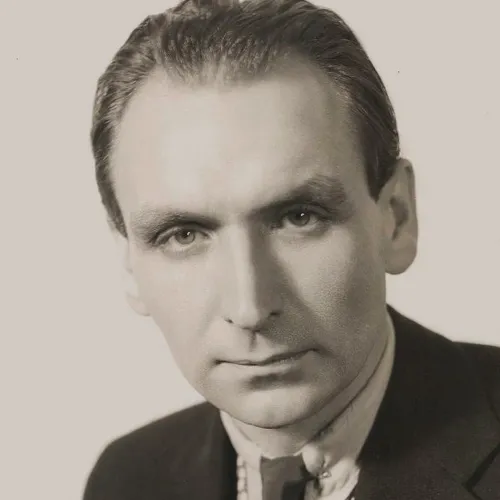
Hans-Werner Janssen (1 June 1899 – 19 September 1990) was an American conductor of classical music, and composer of classical music and film scores.
Biography Janssen was born in New York City on 1 June 1899. His father was the famous New York Restauranter of the Hof Brau Haus and encouraged Werner to enter the family business, opposing the son's desire for a musical career. Therefore, after Werner completed secondary school (graduating from Phillips Exeter Academy) he had to support his own musical education at Dartmouth College. He did this by being a waiter, performing in cabarets and theaters, and selling his own popular compositions. At the New England Conservatory of Music he studied with the composersGeorge Chadwick and Frederick Converse. He also studied piano with Arthur Friedheim, a pupil of Franz Liszt. Janssen entered the US military (infantry) in World War I. After the war he returned to his studies and earned a bachelor's degree in music at Dartmouth College in 1921. He began to compose jazz songs for Tin Pan Alley. He made recordings as a pianist of two of his popular songs in 1920. He composed for the Ziegfeld Follies of 1925 and 1926 and wrote several songs which became national hits. This helped finance his conducting studies with Felix Weingartner in Basel, Switzerland (1920–21) and with Hermann Scherchen in Strasbourg, France (1921–25). He also received a Juilliard Fellowship and the Rome Prize from the American Academy in Rome for his tone poem for large orchestra in a jazz idiom New York's Eve in New York. That composition received its premiere from the Rochester Philharmonic Orchestra conducted by Howard Hanson on May 8, 1929. In 1930, it was performed by the Cleveland Orchestra conducted by Nikolai Sokoloff, and was recorded in 1929 by The Victor Symphony Orchestra conducted by Nathaniel Shilkret. Shilkret and Janssen were later (1945) to exchange roles, with Janssen and his Symphony Orchestra of Los Angeles conducting the Genesis Suite which was conceived of and coauthored by Shilkret. He was engaged in 1927 by the National Broadcasting Corporation to direct symphony concerts on the radio but was dismissed early on. He was also hired in 1929 by Samuel Roxy Rothafel to conduct at his Roxy Theater but was soon dismissed from that post as well. Three years of studying in Rome at the Accademia Nazionale di Santa Cecilia with mentor Ottorino Respighi resulted in several new compositions including the Louisiana Suite and the string quartet American Kaleidoscope performed by the Quartetto di Roma. His work with that group led to an engagement to conduct the Royal Orchestra of Rome. He also took conducting engagements throughout Europe (including Berlin, Budapest, Copenhagen, Riga, Stockholm, and Turin). He conducted an entire concert of the works of Jean Sibelius in Helsinki in February 1934. Sibelius said of this concert: "You may say that tonight Finland has for the first time discovered my music. This achievement of Janssen's is the deed of a hero". After a second concert, he received the Order of the White Rose on 8 March 1936 from the government of Finland for his contribution to Finnish music. He was appointed associate conductor of the New York Philharmonic for the 1934-1935 season, and on 8 November 1934 became the first American-born conductor to lead the orchestra. He was conductor of the Baltimore Symphony Orchestra from 1937 through 1939. While Janssen filled roles as guest conductor, he was also contracted to write film music. His first credited film score was for The General Died at Dawn (1936), which was nominated for anAcademy Award, the first of six Janssen scored films to be nominated. In 1939, he resigned his position with the Baltimore Symphony Orchestra to work with film producer Walter Wanger. He composed several other film scores including Blockade (1938), Winter Carnival (1939), Eternally Yours (1939), Slightly Honorable (1940), The House Across the Bay<span class="Ap