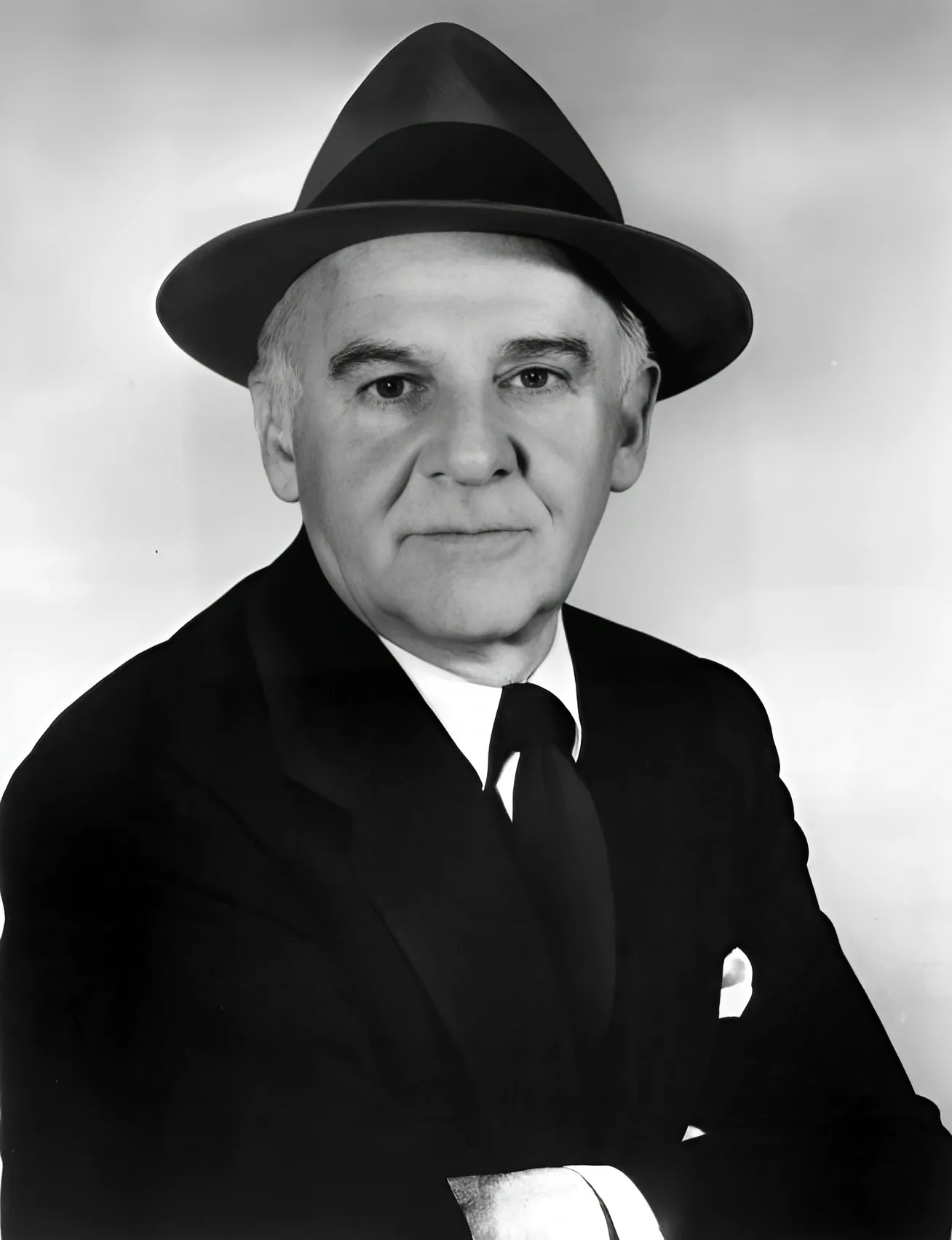
Walter Winchell
Walter Winchell stands as one of the most influential and polarizing figures in American broadcasting history. Born Walter Winschel on April 7, 1897, in New York City, he transformed himself from a vaudeville performer into a media sensation whose reach extended into millions of American homes through newspapers and radio waves. His syndicated gossip column and radio programs made him a household name during the 1930s, 1940s, and 1950s, while his outspoken political views and fierce commentary on current events established him as more than just an entertainment reporter—he was a force that shaped public opinion and celebrity culture itself.
From Vaudeville to Journalism
Winchell's journey to becoming the nation's most famous gossip columnist began in the theatrical world. Performing in vaudeville troupes as a teenager and young adult, he developed the quick wit and observational skills that would later define his writing style. Rather than wait for formal opportunities, the enterprising performer took to posting typed notes about his acting troupe on backstage bulletin boards, complete with carefully crafted puns and personal anecdotes about his fellow performers. This informal practice of sharing theatrical gossip caught the attention of a publisher at the Vaudeville News, who recruited Winchell as a Western correspondent around 1920. By 1927, his contributions to the publication had evolved into a full-time position, marking the official launch of his career as a gossip columnist. In 1924, Winchell transitioned from Vaudeville News to the New York Evening Graphic, where he was given a show-business column titled "On-Broadway." He conducted this column for five years, steadily building a reputation for his distinctive Broadway idiom and sharp observational humor. His success in New York led to a major career advancement when he was hired on June 10, 1929, by the New York Daily Mirror. Here, he became the author of the first syndicated gossip column, also called "On-Broadway," which was distributed nationwide through King Features Syndicate. This syndication represented a watershed moment—Winchell's column now appeared in papers across America, establishing him as the preeminent voice in celebrity gossip and Broadway entertainment reporting.
The Radio Pioneer
Winchell's transition to broadcasting came on May 12, 1930, when he made his radio debut over WABC in New York, a CBS affiliate. His initial program, Saks on Broadway, was a modest 15-minute feature that provided business news about Broadway rather than the gossip and commentary he would become famous for. However, this initial venture proved to be merely the beginning of his dominance in the medium. In 1932, Winchell moved to WJZ (later renamed WABC) and NBC Blue (which would eventually become ABC Radio), where he launched The Jergens Journal, a program that would cement his status as a radio personality. Throughout the 1930s and 1940s, radio became the primary vehicle for Winchell's reach and influence. His weekly radio program became required listening for millions of Americans who tuned in to hear his rapid-fire delivery, trademark greeting "Good evening, Mr. and Mrs. America, and all the ships at sea," and his unique blend of entertainment gossip interspersed with hard-hitting news commentary. The combination proved irresistible to audiences hungry for both celebrity scandals and substantive reporting on world events. His news reports, while always deeply opinionated, created a devoted following that extended his influence far beyond what his newspaper column alone could achieve.
Political Commentary and Controversial Stances
Winchell's influence extended well beyond entertainment gossip when he emerged as one of the first American commentators to attack Adolf Hitler and pro-fascist organizations operating within the United States. During the late 1930s, he vigorously attacked the German-American Bund and its leader Fritz Julius Kuhn, using his platform to denounce American isolationists as appeasing Hitler. He became a staunch supporter of President Franklin D. Roosevelt and the New Deal throughout the Depression era, frequently serving as the Roosevelt Administration's mouthpiece in favor of interventionism as European war crisis loomed. His attacks on prominent isolationists were particularly memorable and vicious. He dubbed Charles Lindbergh "The Lone Ostrich" and denounced Gerald L.K. Smith as "Gerald Lucifer KKKodfish Smith," demonstrating his talent for caustic wordplay deployed in service of his political agenda. During the 1930s and 1940s, Winchell was also an outspoken supporter of civil rights for African Americans, frequently attacking the Ku Klux Klan and other racist groups as supporting un-American, pro-German goals. His anti-fascist credentials and civil rights advocacy positioned him as a progressive voice during this turbulent period. However, Winchell's political evolution took a dramatic turn by the 1950s. He became increasingly archconservative, aligning himself with Senator Joseph McCarthy and his campaign against communists. During World War II, he had attacked the National Maritime Union, which he claimed was run by Communists, and he and influential columnist Drew Pearson attacked Secretary of Defense James Forrestal in columns and radio broadcasts in 1948 and 1949. By the 1950s, Winchell had shifted to viewing Communism as the main threat facing America, and he notoriously supported the blacklisting of actors, writers, and technicians in radio and television suspected of communist sympathies or associations.
Notable Achievements and Legacy
Winchell's ability to leverage his massive popularity for causes he valued demonstrated the extent of his influence. In 1946, following the death of his close friend and fellow writer Damon Runyon from cancer, Winchell appealed to his radio audience for contributions to fight the disease. The response was extraordinary and led Winchell to establish the Damon Runyon Cancer Memorial Fund, later renamed the Damon Runyon Cancer Research Foundation. He led this charitable organization with the support of numerous celebrities, including Marlene Dietrich, Bob Hope, Milton Berle, Marilyn Monroe, and Joe DiMaggio, continuing this work until his death in 1972. Winchell's impact on journalism and broadcasting cannot be overstated. He was viewed by authorities as one of the nation's most prolific phrase-makers, and his rapid-fire delivery and distinctive Broadway idiom influenced how news and gossip were reported for decades. He had been involved with early television as well, serving as the unseen narrator of the television drama series The Untouchables from 1959 to 1963, extending his presence into the emerging medium even as radio's dominance waned. In 1940, he broke the news of President Roosevelt's decision to seek a third term, demonstrating that his reporting extended into serious political territory as well. Winchell's career also extended into entertainment. In 1937, he played the role of newspaper reporter Hildy Johnson in a one-hour adaptation of The Front Page on Lux Radio Theatre on June 28, 1937. His coverage of the Lindbergh kidnapping and subsequent trial received national attention and helped cement his reputation as a serious journalist capable of handling major news stories. Within two years of covering that case, he had befriended J. Edgar Hoover, and he was responsible for turning Louis "Lepke" Buchalter of Murder, Inc. over to Hoover, demonstrating his connections to powerful figures in law enforcement and government. Despite the controversy surrounding his political evolution and his willingness to support McCarthyism and blacklisting, Winchell's popularity remained substantial throughout much of his career. He conducted his widely syndicated newspaper column at the New York Daily Mirror until 1963, maintaining his presence in print even as his radio influence waned. His legacy as the inventor of the modern gossip column and as a pioneering radio personality who proved that news and entertainment could be blended successfully remains significant, though his later political stances have complicated his historical reputation. Walter Winchell died on February 20, 1972, in Los Angeles, California, at the age of 74, succumbing to cancer—the very disease he had fought against through his charitable work. He left behind a complex legacy: a man who had championed civil rights and opposed fascism in his early career but who later embraced McCarthyism and supported the blacklisting of artists. Yet his fundamental contribution to broadcasting remains undeniable—he proved that radio could deliver not just entertainment but also news, opinion, and commentary in a way that captured public attention and influenced American culture.
Works and Appearances
Radio
- Saks on Broadway (1930)
- Lux Radio Theatre (1937)
Television
- The Untouchables (1959–1963)
Film and Theater
- Blessed Event (1932)
- Broadway Thru a Keyhole (1933)
- Wake Up and Live (1937)
- Telephone Time (1956) e
Newspaper Columns
- Vaudeville News (1920–1927)
- Mainly About Mainstreeters (1924)
- On-Broadway (1924–1929)
- On-Broadway (1929–1963)