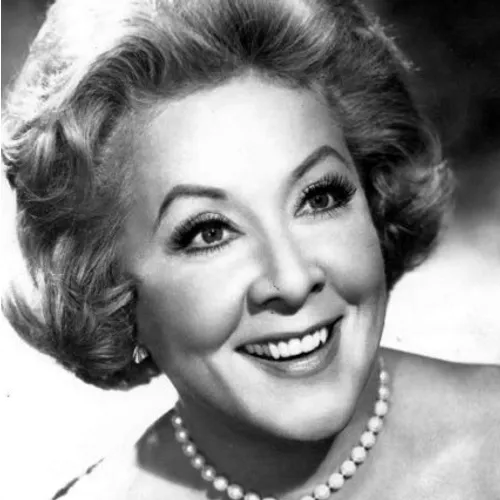
Vivian Vance
Vivian Vance’s voice, timing, and indelible partnership with Lucille Ball placed her squarely at the crossroads of American broadcast comedy. Though she is best remembered for television, she came of age on the stage and worked in an era when radio and TV sensibilities constantly overlapped. As a performer who built characters with rhythm, reaction, and rapport, Vance helped define how the cadences of live comedy could be translated across media—and her work still crackles with that immediacy.
Early Life and Stage Foundations
Vivian Vance was born July 26, 1909, in Cherryvale, Kansas, as Vivian Roberta Jones. She grew up far from the coastal entertainment hubs that would soon shape her career, yet she displayed an early compulsion to perform that carried her from the Midwest to the American Southwest and then on to New York. Those formative years instilled a sturdy discipline and an ease in front of an audience that stayed with her throughout decades of stage and screen work. In Albuquerque, New Mexico, she began acting intensively and, crucially, adopted the professional name that would become famous: Vivian Vance. Local theater gave her the repetitions and risks young performers need; it also compelled the technical skills—projection, timing, and precision—that define the best live comedy. This was training just as relevant to radio studios as it was to small-town stages and Broadway houses. Vance later worked in New York theater, taking on musical and comedic parts that demanded both vocal presence and ensemble cohesion. That training, forged in the give-and-take of live performance, readied her for the exacting demands of national broadcast comedy—where the right pause or glance had to land with split-second accuracy.
From Stage to Screen: The “Lucy” Breakthrough
Vance’s national breakthrough came with the role of Ethel Mertz on I Love Lucy, premiering in 1951. Cast alongside Lucille Ball and Desi Arnaz, Vance provided the essential second lead who could volley gags, ground the absurdity, and capture the audience’s sympathies. As Ethel, she embodied the sharp-witted confidante with a singer’s sense of tempo and a stage actor’s instinct for ensemble. It was the perfect role for her mix of warmth, grit, and comic precision. She continued as Ethel in The Lucy-Desi Comedy Hour from the late 1950s, retaining the character’s bite and buoyancy while navigating new stories and guest stars. Her chemistry with William Frawley (as Fred Mertz) gave the show its double-barreled engine: two couples, two comedic couplings, and a flexible, reactive rhythm that played as well in living rooms as in club sets or theater matinees. In the 1960s, Vance pivoted to a new identity on The Lucy Show, playing Vivian Bagley, a divorced mother and Lucy’s equal in both scheming and survival. It was a landmark character that matched Vance’s strengths—character depth with comedic snap. She later made recurring appearances on Here’s Lucy, further proving her ability to adapt to evolving TV formats while maintaining the intimacy and timing that audiences associated with her best work.
On the Airwaves: Style, Timing, and Broadcast Craft
While Vance’s signature fame comes from television, the style she perfected has its roots in the same performance vocabulary that powered old-time radio: crisp construction, fast exchanges, and a lively relationship with reaction. Her characters worked because her responses worked—her glances and line-readings sounded and felt like exactly what the story needed at that moment. That is how radio audiences experience character: through voice, rhythm, and the internal logic of timing. Vance’s comedic method relied on collaborative precision. She didn’t overpower scenes; she filled them. In the Ethel–Lucy dynamic, she brought a flexible resilience that let the lead’s antics soar without losing stakes or sense. That balance—humor anchored in plausible human responses—mirrors the best radio comedy teams, where the “second banana” often ensures the laughs land with clarity rather than chaos. Because Vance began as a stage actor and excelled in ensemble playing, her broadcast performances emphasized credible emotion and musical pacing. The sensibility is unmistakable: her jokes register as beats in a score, her reactions as counter-melodies, her presence as the steady meter. It’s a craft that radio codified and television perpetuated—and Vance moved through both with assurance.
Collaborations, Conflicts, and Career Choices
Vance’s closest professional bond was with Lucille Ball. Their partnership developed into a personal friendship that transcended the sets and timelines of their shared series. Together, they crafted scenes that made supportive friendship itself a comedic engine—a powerful model for the way secondary leads could be as memorable as stars. Her on-screen work with William Frawley delivered a different energy: the prickly, punchy banter of Ethel and Fred Mertz. Whatever friction the public sensed only underscored how believable their characters were as a long-married pair with a well-worn arsenal of jabs and affections. The Mertzes gave I Love Lucy a second center of gravity and made the show a true quartet. As The Lucy Show evolved, Vance’s Vivian Bagley character marked a fresh arc—distinct from Ethel—and demonstrated her refusal to be typecast. This decision to reshape herself rather than repeat herself reflected a careful stewardship of her professional identity. Later guest turns on Here’s Lucy let her reaffirm that identity at moments of her choosing, on terms that respected both her history and her range.
Legacy and Influence
Vivian Vance died on August 17, 1979, leaving behind work that remains core curriculum for anyone studying American broadcast comedy. As an actress who kept one foot in the stage tradition while mastering the beats of televised farce, she showed how a performer could be intimate and larger-than-life at once. Her legacy is equally technical and emotional. Technically, Vance modeled the art of shared timing—how to bend a scene toward laughter by calibrating breath, speed, and silence. Emotionally, she presented friendship as a comedic superpower, elevating the lead while defining herself. That combination shaped audience expectations for ensemble comedy for decades to come. For historians of radio and television alike, Vance is proof that media boundaries are porous when the craft is sound. She brought stage-honed stamina and radio-ready rhythm to the camera—and, in doing so, ensured that Ethel Mertz and Vivian Bagley live wherever classic comedy plays.
Works and Appearances
Television
- I Love Lucy (1951–1957)
- The Lucy-Desi Comedy Hour (1957–1960)
- The Lucy Show (1962–1965)
- Here’s Lucy (late 1960s–early 1970s)