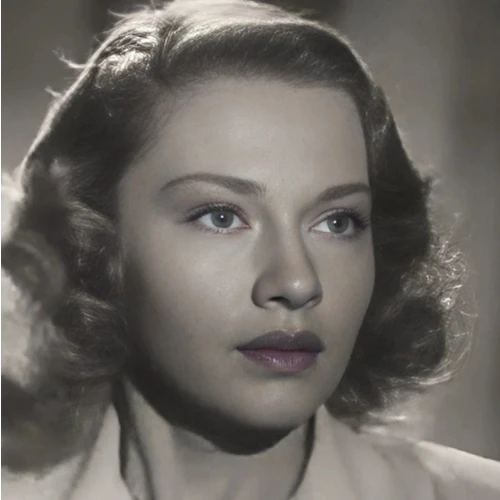
Virginia Christine
Virginia Christine stands as one of radio and television's most prolific character actresses, with a career spanning multiple decades and diverse media. Born Virginia Christine Ricketts on March 5, 1920, she would become a fixture in American homes through both her extensive work in classic radio dramas and her iconic portrayal of Mrs. Olson in the legendary Folgers Coffee commercials. Yet before she became synonymous with a coffee brand, Christine built a reputation as a versatile performer who could embody nearly any role thrown her way. Her journey from a small Iowa town to the heights of entertainment industry success represents a compelling chapter in broadcasting history, one defined by talent, persistence, and an uncanny ability to connect with audiences across generations.
From Stanton to Los Angeles: Early Life and Radio Beginnings
Virginia Christine was born in Stanton, Iowa, in the heart of America's heartland. Like many performers of her generation, she gravitated toward entertainment while still in her formative years. Her theatrical training came under the guidance of accomplished actor/director Fritz Feld, whom she would eventually marry in 1940. This partnership would prove transformative, not only for her personal life but also for her professional trajectory. When her family relocated to Los Angeles, Christine seized the opportunity to pursue her ambitions in the entertainment capital. While attending the University of California, Los Angeles (UCLA), she began working in radio, laying the groundwork for what would become a remarkably sustained career in broadcasting. The timing proved fortuitous—radio was reaching its golden age, with networks hungry for talented performers who could bring scripts to life through voice and performance alone. Her entry into radio during her college years demonstrated early initiative and ambition. Radio work at this time was competitive, demanding performers who could master various accents, ages, and character types on the fly. Christine's ability to handle these demands would eventually lead to more substantial roles and recurring assignments across multiple programs.
The Radio Years: A Versatile Performer Across Multiple Programs
Christine's radio career reveals the breadth of her versatility and the confidence networks placed in her abilities. She became a familiar presence on the airwaves, appearing in 23 episodes of the radio version of Gunsmoke, beginning with the episode "Cholera" on December 4, 1954, and continuing through "Good Girl, Bad Company" and other installments. Her ability to inhabit different characters across these episodes showcased the skill required of radio performers—the capacity to be unrecognizable from one role to the next, relying entirely on voice modulation and dramatic interpretation. During this era, Christine worked with some of the most respected names in radio broadcasting. Her recurring roles and guest appearances demonstrated that she had become a performer that producers and directors wanted to work with repeatedly. Radio offered an environment where pure acting talent mattered most; there was no visual medium to rely upon, no physical appearance to trade on. Everything depended on the quality of the performance itself. The radio work also served as training ground for the later television success that would define her career. Radio taught performers discipline, the ability to work efficiently within tight schedules, and the skill of creating believable characters with minimal resources. These lessons would serve Christine well as she transitioned into television and film, where her radio experience gave her an edge over performers who lacked such thorough preparation.
Breaking into Film and Television: Building a Broader Career
In 1942, Christine signed a contract with Warner Bros., marking her official entry into the motion picture industry. Her first film for the studio was Edge of Darkness (1943), in which she played a Norwegian peasant girl. Though her time with Warner Bros. proved brief—the studio dropped her in 1943—this initial film work opened doors that would lead to a more fruitful partnership elsewhere. Universal Pictures signed Christine in 1944, and her work there included supporting roles in The Mummy's Curse and The Wife of Monte Cristo. Notably, she began appearing alongside her husband Fritz Feld in various productions, including the 1963 Western 4 for Texas, creating a unique dynamic as a husband-and-wife acting team navigating Hollywood's demanding landscape. Christine's television career gained momentum throughout the late 1950s and 1960s. She made guest appearances on numerous programs, including Coronado 9, Rawhide, and The Untouchables in 1960 and 1961. From 1961 to 1962, she took on a recurring role as widow Ovie Swenson in the Western series Tales of Wells Fargo, demonstrating her ability to sustain character work over multiple episodes. Her appearances on Perry Mason included memorable roles as defendant Beth Sandover in the season-six episode "The Case of the Double-Entry Mind" (1962) and murderer Edith Summers in "The Case of the Devious Delinquent" (1963). Throughout the remainder of the 1960s, Christine maintained a steady presence in television, guest-starring on an impressive array of shows: 77 Sunset Strip, Ben Casey, Bonanza, The Fugitive, Hazel, Wagon Train, The Virginian, The Big Valley, Going My Way, The F.B.I., and Daniel Boone. In 1969, she co-starred in the ABC television movie Daughter of the Mind, marking another significant credit in her expanding résumé. She was favored by filmmaker Stanley Kramer, appearing in a number of his productions, cementing her status as a reliable, respected performer in the industry.
The Mrs. Olson Years: Becoming an American Icon
Christine's greatest fame arrived in 1965 when she began her extraordinary 21-year stint as the matronly Mrs. Olson, the character who became inextricably linked with her name and face. In these commercials for Folgers Coffee, Mrs. Olson dispensed warmth and maternal wisdom to young married couples while pouring coffee, embodying a particular vision of American domesticity and comfort. The character's appeal proved nearly universal; Christine went on to appear in over 100 commercials for Folgers, making her one of the most visible performers in advertising history. The commercials' success transcended typical advertising metrics. Mrs. Olson became so culturally embedded that comedians and entertainers began parodying the character, including Carol Burnett, Johnny Carson, Bob Hope, Ann-Margret, and Jackie Gleason. This level of cultural saturation—where a commercial character becomes worthy of parody by the era's most prominent entertainers—speaks to the profound impact Christine's work had achieved. She had transformed a product endorsement into a cultural phenomenon, and her face and voice became instantly recognizable across America. The character's reach extended even to her hometown. In 1971, Stanton, Iowa, honored Christine by transforming the city's water tower to resemble a giant Swedish coffee pot, a tribute that underscored her significance both to the entertainment industry and to her community of origin. This gesture symbolized how completely Mrs. Olson had penetrated American consciousness—even in small-town Iowa, the character had become a point of pride and identification.
The Later Decades: Continuing Work and Legacy
During the 1970s, Christine continued her television work, maintaining a professional presence even as her most visible role remained the Folgers commercials. She appeared in various television programs, demonstrating that her career extended well beyond the coffee campaigns. Her final acting role came in 1979 on the animated series Scooby-Doo and Scrappy-Doo, where she provided additional voices, bringing her professional acting career full circle—from radio voices to animated voices, both mediums where pure vocal performance remained paramount. Christine retired from acting in 1979, concluding a career that had spanned multiple decades and numerous media formats. Rather than disappearing from public life entirely, she remained engaged with her community and various causes. She performed volunteer work at Planned Parenthood and served as a judge at the American College Theatre Festival, roles that allowed her to contribute to the arts and society without the demands of active performance. Later, she was appointed honorary mayor of Brentwood, Los Angeles, where she and her husband had resided for many years, a fitting recognition for someone who had become a cultural institution herself.
Works and Appearances
Radio
Gunsmoke (radio version)
- "Cholera" (1954)
- "Poor Pearl" (1955)
- "Change of Heart" (1955)
- "Good Girl, Bad Company
Cinema
- Edge of Darkness (1943)
- The Mummy's Curse (1944)
- The Wife of Monte Cristo (1944)
- 4 for Texas (1963)
Television
- Coronado 9 (1960–1961)
- Rawhide (1960–1961)
- The Untouchables (1960–1961)
- Tales of Wells Fargo (1961–1962) n
Advertising
- Folgers Coffee Commercials (1965–1986) – Over 100 commercials as "Mrs. Olson" across 21 years