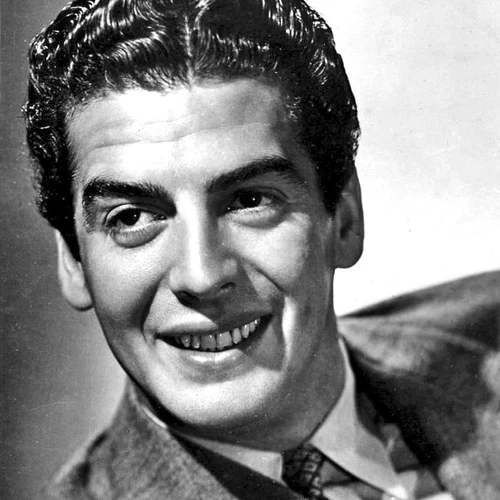
Victor Mature
Victor John Mature (1913-1999) stands as one of Hollywood's most prolific performers, yet his contributions to broadcasting history remain largely overshadowed by his film career. While audiences remember him as the muscular leading man of Samson and Delilah and The Robe, fewer recall his appearances on radio, where he lent his commanding voice to dramatic productions during broadcasting's golden age. This article examines Mature's multifaceted entertainment career, with particular attention to his work in radio broadcasting and the unique path that led this ambitious young performer from candy sales to Hollywood stardom.
The Road to Entertainment
Born on January 29, 1913, Victor Mature's journey to stardom proved unconventional. Before pursuing his theatrical ambitions, Mature worked as a teenager alongside his father, Marcello Maturi, selling butcher supplies. His father, a Kentucky knife-sharpener descended from the Alpine village of Pinzolo in Italy, provided young Victor with a working-class foundation that would inform his later career choices and personal philosophy. Mature's determination to break into entertainment led him to California, where he enrolled at the Pasadena Community Playhouse, one of the era's most respected training grounds for aspiring performers. The Playhouse proved transformative; for three years, Mature lived in a tent in the backyard of Mrs. Willigan, mother of fellow student Catherine Lewis, while honing his craft on stage. This period of genuine hardship demonstrated Mature's commitment to his art—he wasn't born into privilege but earned every opportunity through dedication and perseverance. While still at Pasadena, Mature became acquainted with other aspiring actors who would rise to prominence in Hollywood. Among his fellow students was George Reeves, who would later achieve fame in television. Mature auditioned for Gone with the Wind (1939) for a role that ultimately went to Reeves, a disappointment that proved temporary as Mature's break would come through different channels.
The Contract Years and Radio Work
Mature's big break came when Charles R. Rogers, an agent for producer Hal Roach, discovered him performing in the stage production To Quito and Back. Rogers immediately recognized Mature's potential, famously calling him "a rival to Clark Gable, Robert Taylor and Errol Flynn." In September 1939, Mature signed a seven-year contract with Roach, launching his professional career in earnest. During this early period, Mature's radio work became an integral part of his developing resume. On October 21, 1940, Mature appeared on the prestigious Lux Radio Theater broadcast, taking the role of "Alexander Moore" in an adaptation of Lillian Russell. This appearance on one of radio's most celebrated dramatic programs demonstrated that his appeal transcended the silver screen. The Lux Radio Theater, sponsored by Lux soap and directed by prestigious productions, offered Mature the opportunity to showcase his dramatic abilities to millions of listeners. Beyond the Lux Radio Theater, Mature's radio portfolio extended to other significant productions. He appeared in Suspense, the legendary thriller series that specialized in atmospheric crime and mystery dramas. On December 10, 1951, Mature appeared in the episode "Black Jack to Kill," demonstrating his range in the genre. Later, on February 16, 1953, he returned to Suspense for "The Love and Death of Joaquin Murieta," further cementing his presence in radio's dramatic landscape. These appearances revealed Mature's versatility as a performer capable of delivering intense, nuanced performances across multiple dramatic scenarios. On January 12, 1948, Mature again graced the Lux Radio Theater microphones, this time in a radio adaptation of Kiss of Death, the noir thriller that would become one of his signature film roles. The fact that he reprised this role on radio demonstrates how successful film performances often translated into broadcast opportunities, creating a synergy between Hollywood and the radio industry during the late 1940s.
Transition and Legacy
By the early 1950s, Mature's focus increasingly shifted toward cinema and television, as film productions became more lucrative and offered greater visibility than radio work. However, his radio appearances during the 1940s and early 1950s represent an important chapter in understanding his complete career trajectory. Radio provided Mature with opportunities to refine his craft in live, dramatic contexts before studio audiences—skills that enhanced his film performances. Mature's eventual retirement from acting and subsequent embrace of golf—reportedly his true passion—reflected a man who never took himself or his celebrity status too seriously. The famous story of his rejection by the exclusive Los Angeles Country Club captures his practical attitude perfectly. When informed that the club didn't accept actors as members, Mature's response was characteristically blunt: "I'm not an actor—and I've got 64 films to prove it!" This quip reveals a performer who viewed his entertainment career as a job rather than a sacred calling, distinguishing him from many of his contemporaries who cultivated more precious artistic personas. His contributions to radio broadcasting, while modest compared to his film legacy, reflect the interconnected nature of entertainment media during the mid-twentieth century. Radio performers who successfully transitioned to film often maintained their radio presence, creating a multimedia presence that kept them visible across multiple platforms. Mature exemplified this crossover dynamic, using radio appearances to supplement his film career while maintaining relevance with audiences who preferred listening to dramatic performances on their home receivers.
Works and Appearances
Radio
- Lux Radio Theater – "Lillian Russell" (1940) – Role: Alexander Moore
- Lux Radio Theater – Kiss of Death adaptation (1948)
- Suspense – "Black Jack to Kill" (1951)
- Suspense – "The Love and Death of Joaquin Murieta" (1953)
Film (selected major roles)
- One Million B.C. (1940)
- Song of the Islands (1942)
- My Darling Clementine (1946) – Role: Doc Holliday
- Kiss of Death (1947)
- Cry of the City (1948)
- Samson and Delilah (1949)
- Million Dollar Mermaid (1952)
- The Robe (1953)
- The Egyptian (1954)
- After the Fox (1966)
- Won Ton Ton: The Dog Who Saved Hollywood (1976)
- Firepower (1979)
Television
- Samson and Delilah – TV Movie (1984) – Role: Manoah