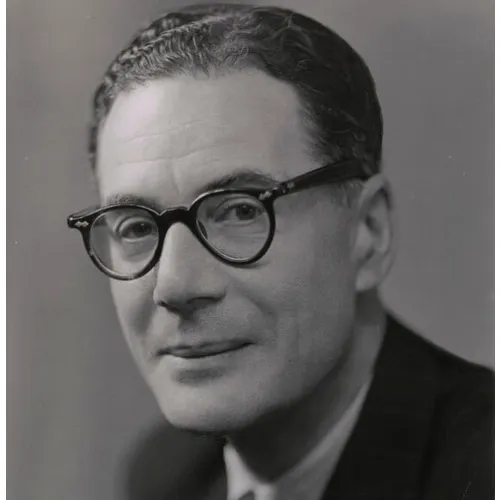
Val Gielgud
Val Gielgud stands as one of broadcasting's most transformative figures, a man who essentially invented the language of radio drama during its formative years. Born into a theatrical dynasty that included his famous actor brother Sir John Gielgud and a connection to Victorian stage legend Dame Ellen Terry, Val possessed an unusual path to becoming the architect of BBC radio's dramatic output. What makes his story particularly compelling is that he arrived at this position of extraordinary influence with virtually no prior experience in radio production—a paradox that underscores both his innate talents and the experimental nature of early broadcasting. Over more than three decades, he would shape how audiences heard stories on the wireless, pioneering techniques that remain fundamental to audio drama today.
From Parliament to the Pages of Radio Times
Val Henry Gielgud was born on 28 April 1900 in London into a world of theatre and performance. After attending Oxford University, he initially charted a conventional path, taking a position as secretary to a Member of Parliament. This career, however, proved merely a waystation. Gielgud soon gravitated toward writing, securing work as a sub-editor at a comic book and magazine publisher. Fortune intervened when this position led him to the BBC's own listings magazine, Radio Times, where he joined as assistant to the editor Eric Maschwitz. At Radio Times, Gielgud found his voice as a critic of the corporation's dramatic output. While his editorial duties kept him removed from actual production work, he wielded his pen with considerable effect. In his autobiography, Gielgud would later confess to a rather audacious strategy: he authored numerous letters appearing on the magazine's correspondence page, purportedly from listeners, criticizing various aspects of the BBC's drama productions. These carefully crafted missives gave voice to his theories about what radio drama could and should become. By positioning himself as the voice of the listening public, Gielgud built a compelling case for reform before he had ever directed a single broadcast.
The Unexpected Appointment to BBC Radio Drama
In January 1929, the BBC made an extraordinary decision. The corporation appointed Gielgud as Head of Productions at BBC Radio Drama—essentially the director of all radio drama output for the entire network. He succeeded R. E. Jeffrey, the very man whose work Gielgud had been systematically criticizing through his Radio Times campaign. By his own admission in his 1947 autobiography Years of the Locust, Gielgud had believed "there was as little chance of my directing radio drama as of superseding Sir John Reith himself." He was, by his own assessment, "profoundly ignorant of the department's problems" and evaluated his attitude toward broadcast drama as that of "an average supercilious listener." Yet Gielgud proved far more than his credentials suggested. Despite having never previously directed a radio play, he remained in the position for the next twenty years, overseeing all of the radio drama produced during this crucial period. He wrote many plays himself and appeared in small acting roles across six of them. Most significantly, Gielgud became the theorist and innovator who transformed radio drama from a literary adaptation medium into an art form with its own distinct possibilities. He constantly reminded those working under him that radio drama could employ vastly larger casts and exotic settings impossible on stage, and he held a revolutionary theory: while stage plays could only show the actions of characters, radio possessed the unique power to venture inside their minds.
Pioneering the Techniques of Audio Drama
Gielgud is widely credited with inventing many of the fundamental techniques of radio drama that endure today. His most significant early opportunity to test his theories came in July 1930, when he was invited to oversee an experimental television transmission—a development we will address shortly. More importantly, his work throughout the 1930s established the aesthetic principles that would define BBC radio drama for decades. His collaborative relationships proved particularly fruitful. Gielgud formed a significant partnership with celebrated mystery writer Dorothy L. Sayers, producing radio adaptations of her novels. Most notably, he directed her immensely popular cycle of radio plays titled The Man Born to Be King during 1941-1942, which achieved considerable success during the Second World War and demonstrated the emotional power of serialized radio drama. He also collaborated successfully with mystery writer John Dickson Carr, with more than sixty of their collaborative works eventually collected decades later in the volume 13 to the Gallows (edited by Tony Medawar, 2008). Following the war, Gielgud remained a commanding figure in BBC radio. In the 1950s, he directed a successful run of Sherlock Holmes radio plays featuring his brother John Gielgud in the title role, with Ralph Richardson as Dr. Watson, broadcast on the BBC's Light Programme. Gielgud himself occasionally appeared in supporting roles, including at least one performance as Mycroft Holmes.
Television and the Later Career
In July 1930, Gielgud was invited to oversee the experimental transmission of a short drama on television, the new medium that would eventually compete with radio for audiences' attention. The production selected was The Man With the Flower in His Mouth by Italian playwright Luigi Pirandello, chosen because of its confined setting, small cast, and approximately thirty-minute length. This early television work signaled Gielgud's willingness to venture into emerging media, though his primary focus remained radio throughout the 1930s. In 1939, Gielgud returned to television on secondment to the BBC Television Service at Alexandra Palace, which had become a full-fledged, high-definition network broadcasting to the London area. He produced a short play called Ending It, an adaptation of one of his own short stories, which was transmitted on 25 August 1939 and starred John Robinson and Joan Marion. He had also rehearsed a full-length play, but it was cancelled from its scheduled slot on the evening of 1 September when the television service was suspended in anticipation of the declaration of war. After the Second World War, Gielgud moved to television on a more permanent basis, becoming Head of BBC television drama shortly after the service's return in 1946. However, this period did not match the success of his radio work. Many producers under him felt he lacked great enthusiasm for television or genuine appreciation for what it could achieve that radio could not. His tenure in this role was not regarded as a success, and in 1952, he left the television service, being replaced by the experienced producer Michael Barry.
Legacy and Lasting Influence
By the time Gielgud relinquished his position as Head of Radio Drama in April 1963 upon his retirement, having reigned for over three decades, his influence on the medium was immeasurable. Yet his later years also revealed the generational limits of his vision. By the 1950s, he found himself in conflict with younger colleagues who championed experimental modern playwrights such as Harold Pinter and Samuel Beckett. Notably, Beckett's Waiting for Godot would have made its English début in a radio production had Gielgud not rejected it, a decision that represents a notable blindspot in his otherwise visionary approach to the medium. Gielgud published a book titled British Radio Drama, 1922-1956 in 1957, which documented the evolution of the form during its most transformative period, though it long fell out of print. He lived through the transition from radio's golden age into the television era and witnessed the medium's transformation. Val Gielgud died on 30 November 1981 in London, having spent virtually his entire professional life at the BBC. Gielgud's legacy rests not merely on the plays he produced or the collaborations he fostered, but on the theoretical framework he established for understanding radio as a distinct artistic medium. His insistence that radio could access the interior mental lives of characters, that it could imagine vast worlds and multitudes of characters without the constraints of stage production, fundamentally shaped how drama would be created for the medium. In establishing these principles and proving they could succeed with audiences, Gielgud demonstrated that radio drama was not merely theatre adapted for wireless transmission—it was its own art form entirely.
Works and Appearances
Radio
- Radio Times (1920s)
- Sherlock Holmes series (1950s)
- The Man Born to Be King by Dorothy L. Sayers (1941-1942)
- 13 to the Gallows (compilation of works with John Dickson Carr)
- Various adaptations of Dorothy L. Sayers novels
Television
- The Man With the Flower in His Mouth by Luigi Pirandello (July 1930) —
- Ending It (25 August 1939)
- BBC Television Service (1946-1952)
Publications
- Years of the Locust (1947)
- British Radio Drama, 1922-1956 (1957)
Theatre
- Productions featuring Sir John Gielgud
Film
- Death at Broadcasting House