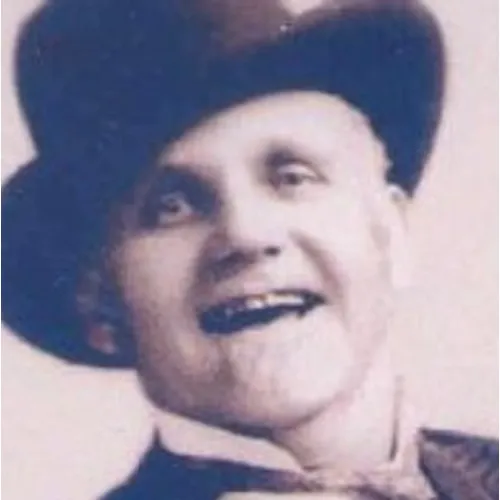
Uncle Dave Macon
Before there was Elvis or Hank Williams, before Nashville became Music City USA, there was Uncle Dave Macon—a banjo-picking entertainer with gold teeth, a plug hat, and the infectious energy of a man who never seemed to stop performing. Born during the era of mule-drawn wagons and dying just as television began reshaping American entertainment, David Harrison Macon bridged two musical worlds and helped transform folk traditions into the commercial entertainment industry that defines country music today. His journey from freight-line operator to "The Dixie Dewdrop" represents one of old-time radio's most improbable and captivating success stories.
From Hotel Lobby to Vaudeville Stage
Uncle Dave Macon entered the world on October 7, 1870, in Smartt Station, a rural corner of Warren County in Middle Tennessee. Born into a well-to-do family with roots stretching back to North Carolina, young Dave grew up in a household that valued both entrepreneurship and culture. His father, Confederate Captain John Macon, and his mother, Martha Ramsey, were pillars of their community. When Dave was just thirteen years old, the family relocated to Nashville to operate the Old Broadway Hotel, a decision that would fundamentally shape his destiny as an entertainer. The Broadway Hotel became the crucible of Macon's artistic development. Located in the heart of downtown Nashville, the establishment catered to traveling minstrels, circus performers, and vaudeville acts making their way along the entertainment circuit. Young Dave became utterly captivated by these transient artists. At age thirteen, he begged his mother to purchase him a banjo, which he quickly mastered. More importantly, his exposure to the performers passing through the hotel—their showmanship, their comedic timing, their ability to command an audience—imprinted itself on the adolescent's imagination. He attended carnivals and vaudeville productions throughout Nashville, developing an appreciation for public performance that would consume the rest of his life. Tragedy struck in 1886 when John Macon was murdered outside the hotel. His widowed mother sold the property and relocated the family to Readyville, Tennessee, where she operated a country inn and stagecoach stop. Rather than abandon his musical interests, young Dave found new venues. He began entertaining guests at his mother's establishment, performing on a homemade stage with his inseparable banjo. In 1889, Macon married Matilda Richardson and relocated to a farm near Kittrell, Tennessee, where he and his wife raised six sons. Around 1900, he established The Macon Midway Mule and Mitchell Wagon Transportation Company, operating a freight line between Murfreesboro and Woodbury. For two decades, as he drove along with his mules hauling freight and produce, he would entertain people at stops along the way, singing and playing banjo.
The Unlikely Rise of a Fifty-Year-Old Entertainer
The arrival of automobile-based competition threatened Macon's mule business, forcing him to close down in 1920. This setback, however, liberated him to pursue his true passion. Macon's first professional performance came in 1921 at a school in Morrison, Tennessee, during a Methodist church benefit. Two years later, his fortunes changed dramatically. During a 1923 performance for the Shriners in Nashville, Macon was spotted by Marcus Loew of Loews Theatres, who offered him fifteen dollars to perform at a theater in Alabama. After that performance, the manager of Loews Theatres in Birmingham was so impressed he offered Macon several hundred dollars per week—an extraordinary salary for the era. This opportunity unlocked a vast network. Macon began touring the southeastern United States in 1923, initially accompanied by fiddler Sid Harkreader and five other acts. At an age when most men settle into retirement, Macon found himself ascending to genuine stardom. The Sterchi Brothers Furniture Company, which distributed Vocalion Records, recognized Macon's potential as a recording artist. On July 8, 1924, Macon and Harkreader traveled to New York City and made their first recordings for Vocalion, an extended session that produced eighteen songs over several days. By late 1925, Macon had added "Dancing Bob" Bradford, a buck dancer, to his touring act. On November 6, 1925, Macon and Harkreader performed at the Ryman Auditorium—which would become the legendary home of the Grand Ole Opry—in a police department benefit. The show occurred just three weeks before the Opry would launch as the WSM Barn Dance.
The Grand Ole Opry's First Star
Macon was among the first performers at the new WSM radio station. On December 26, 1925, he and fiddler Uncle Jimmy Thompson appeared together on the WSM Saturday night program. This moment marked the beginning of an unprecedented 26-year association with the station that would define his legacy. In early 1927, Macon formed the Fruit Jar Drinkers, composed of Macon, Sam McGee, Kirk McGee, and Mazy Todd. The group recorded for the first time on May 7, 1927, establishing a musical partnership that would produce both traditional songs and fiddle numbers, occasionally recording religious material under the altered group name the Dixie Sacred Singers. Though Macon's career with WSM and the Grand Ole Opry lasted 26 years, his continued touring meant he was not always a regular performer in those early Opry years. Nevertheless, his importance to the institution was immeasurable. Macon became the first star of the Grand Ole Opry—the organization's inaugural headliner who helped establish the show's reputation and commercial viability. Between 1924 and 1938, he recorded over 170 songs, creating an archive of American folk and popular music that would influence generations of musicians. His recording output extended beyond his early Vocalion sessions. In December 1930, Macon recorded for Okeh Records. Later, in 1934, he worked with Gennett Records, and on January 22, 1935, he began recording for Bluebird Records with the Delmore Brothers. A few years later in 1938, he recorded with Glenn "Smoky Mountain" Stagner. Between 1930 and 1952, his son Dorris frequently accompanied him, playing guitar in his performances and recordings.
The Performer's Performer
What truly distinguished Uncle Dave Macon from his contemporaries was not his technical prowess as a banjo player—musicologists have identified no fewer than 19 distinct picking styles across his recordings—but rather his unparalleled stage presence. Bandmate Kirk McGee captured the essence of Macon's personality: "All day long, from morning till midnight, it was a show." Macon performed in a constant state of theatrical display, kicking and stomping while playing, shouting sporadically, and taxing the skills of WSM's early volume-control engineers. He peppered performances with jokes and comedic monologues, engaging in witty repartee with sidemen like Sam McGee and Sid Harkreader. Other country entertainers marveled at his abilities. Roy Acuff reflected, "There was never a person that I have come in contact with in the entertainment world that was more individual than Uncle Dave Macon. He was a self-made entertainer who seemed to copy nobody." His visual presentation was equally distinctive. Adorned in his plug hat, gates-ajar collar, and gold teeth, Macon cultivated an unmistakable persona that made him instantly recognizable. This combination of showmanship and authenticity—his refusal to compromise his personality or water down his performances for commercial appeal—kept him employed when many of his peers could not sustain careers during the Depression. His repertoire reflected his life experiences. Songs like "From Earth to Heaven" described his days hauling goods for his shipping company, while "Wreck of the Tennessee Gravy Train," recorded in 1930, served as political commentary on a financial scandal involving Tennessee Governor Henry Hollis Horton and The Tennessean newspaper.
Hollywood, Later Years, and Legacy
In 1940, Macon received an invitation to participate in the Republic Pictures film Grand Ole Opry. Alongside Opry founder George D. Hay, rising Opry star Roy Acuff, and his son Dorris Macon, the 69-year-old performer traveled to Hollywood. The film captures rare footage of Macon performing, including a memorable duet of "Take Me Back to My Carolina Home" with Dorris, in which the elderly entertainer jumps out of his seat and dances throughout the song's second half—a testament to his seemingly inexhaustible energy. Although Macon toured with Bill Monroe in the late 1940s, he remained skeptical of the emerging bluegrass style and unimpressed by Earl Scruggs' revolutionary banjo technique. Macon also toured throughout the South with Opry headliners including DeFord Bailey and Roy Acuff. Macon continued performing until shortly before his death on March 22, 1952, at Rutherford County Hospital in Murfreesboro. His funeral was attended by more than 5,000 people, with pallbearers including George D. Hay, Kirk McGee, Roy Acuff, and Bill Monroe—a final gathering that testified to the profound impact he had made on American music and the people who created it. In 1966, Macon was inducted posthumously into the Country Music Hall of Fame. His son Dorris and several bandmates, often including Sam and Kirk McGee, made sporadic appearances on the Grand Ole Opry as the Fruit Jar Drinkers until the early 1980s. Every July, the city of Murfreesboro celebrates "Uncle Dave Macon Days," hosting national competitions for old-time clogging, buckdancing, and old-time banjo. His historic house still stands on Old Woodbury Pike in Kittrell, Tennessee, listed on the National Register of Historic Places, and in 2014, the bridge over Cripple Creek in Kittrell was renamed the Uncle Dave Macon Bridge.
Works and Appearances
Radio
WSM/Grand Ole Opry (1925–1952)
- First appearance: December 26, 1925, with Uncle Jimmy Thompson
- Regular performer and headliner on the Grand Ole Opry for 26 years
- One of the first individual stars of the Grand Ole Opry
Film
- Grand Ole Opry (1940, Republic Pictures)
Legacy Recognition
- Country Music Hall of Fame
- Uncle Dave Macon Days – Annual festival held in Murfreesboro each July during the second full weekend
- Uncle Dave Macon Bridge – Renamed in 2014, spanning Cripple Creek in Kittrell, Tennessee
- Uncle Dave Macon House – Historic residence in Kittrell, Tennessee, listed on the National Register of Historic Place