Tom Tully
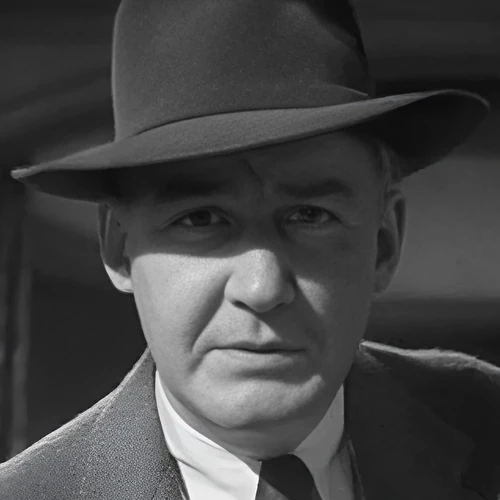
Tom Tully carved out a distinctive career spanning multiple entertainment mediums, establishing himself as a versatile character actor whose work encompassed the golden age of radio, Broadway theater, and Hollywood cinema. Born Thomas Kane Tulley on August 21, 1908 in Durango, Colorado, Tully would become one of the era's most reliable supporting players, known for his ability to embody a wide range of characters with authenticity and depth. His path to stardom was unconventional—beginning in journalism before discovering that acting offered better financial prospects—and his success would eventually earn him an Academy Award nomination and a star on the Hollywood Walk of Fame.
From Colorado to Broadway: The Road to Professional Acting
Tully's early life in southwestern Colorado shaped his work ethic and practical approach to show business. After serving in the United States Navy, he took employment as a reporter for the Denver Post, but the allure of a more lucrative career in entertainment proved compelling enough to prompt a dramatic career change. This pragmatic motivation—seeking better pay rather than pursuing an artistic passion—characterized Tully's no-nonsense approach to his craft throughout his life. His theatrical career began with his Broadway debut in Call Me Ziggy (1937), immediately establishing him within New York's theatrical community. The late 1930s and early 1940s proved to be his most active period on stage, with Tully accumulating an impressive list of Broadway credits that demonstrated his ability to secure roles in quality productions. Among his notable stage appearances were The White Steed (1939), Night Music (1940), The Time of Your Life (1940), Ah, Wilderness! (1941), Jason (1942), The Strings, My Lord, Are False (1942), and The Sun Field (1942). These roles positioned Tully as a seasoned character actor with legitimate theatrical credentials, a reputation that would serve him well as he transitioned into radio and film work.
The Golden Age of Radio: Creating Memorable Characters
Tully's radio work during the 1940s and early 1950s demonstrated the medium's collaborative nature and the breadth of dramatic roles available to skilled character actors. His most prominent radio role came as Joe, the lead character in the serial Home of the Brave, where he carried significant narrative weight rather than merely playing supporting parts. This leading role distinguished him among radio actors, many of whom became typecast in specific character types throughout their careers. Beyond his starring vehicle, Tully proved his range by inhabiting distinctly different characters across multiple programs. He played Jim Carroll in the serial Life Begins, bringing his talents to another serialized drama that demanded consistency and emotional depth across multiple episodes. In the comedy My Mother's Husband, Tully demonstrated his lighter touch by portraying Uncle Willie, proving his versatility extended beyond dramatic material. He also took on the role of Charles Martin in the serial Stella Dallas, further diversifying his radio portfolio with yet another character type and dramatic context. Perhaps his most enduring radio work came through his frequent guest appearances on Gunsmoke, where he portrayed a wide range of parts throughout the series' long run. This recurring work on radio's most prestigious Western drama showcased Tully's ability to create distinct characters repeatedly, never allowing audiences to lock him into a single persona. These appearances kept him actively working in radio even as the medium began its gradual decline in the early 1950s, maintaining his prominence in the industry during its final flourishing years.
Film Success and Industry Recognition
Tully's transition to Hollywood began earlier than many of his radio contemporaries. Following a brief uncredited appearance in Carefree (1938), he secured his first notable film role as the father of Shirley Temple's character in I'll Be Seeing You (1944), gaining visibility in a major studio production. From this point forward, Tully's film career accelerated steadily, establishing him as a reliable supporting player in Hollywood productions. His greatest cinematic achievement came in 1954 with The Caine Mutiny, where he portrayed the first commander of the USS Caine alongside Humphrey Bogart. His supporting performance earned him an Academy Award nomination for Actor in a Supporting Role, a recognition that legitimized his work in the film industry and elevated his professional standing. This Oscar nomination represented the pinnacle of his film career recognition, though he would continue working in Hollywood for nearly two decades afterward. Remarkably, Tully's film career extended well into the 1970s, demonstrating impressive longevity in an industry notorious for discarding aging actors. His final feature film role exemplified his continued willingness to take unglamorous parts: in Don Siegel's 1973 crime film Charley Varrick alongside Walter Matthau and Joe Don Baker, Tully played a crooked gun dealer seated in a wheelchair after having his left leg removed close to the hip. This unflinching portrayal of a disabled criminal demonstrated his commitment to realistic character work regardless of the role's dignity or comfort level.
Television's Steady Work: The Lineup and Beyond
Television became Tully's primary professional focus during the latter half of his career, offering consistent work over extended periods. From 1954 through 1960, he played police Inspector Matt Grebb on the CBS police drama The Lineupalongside co-star Warner Anderson, appearing in 185 episodes across six years of production. This long-running role provided Tully with steady employment and established him as a familiar television presence for millions of viewers. The series, later known as San Francisco Beat in syndication, drew on actual cases from San Francisco police files and benefited greatly from Tully's authoritative presence and professional bearing. Beyond his starring role on The Lineup, Tully remained active in television guest appearances throughout the 1960s. He made two appearances as Rob Petrie's father on CBS's The Dick Van Dyke Show in 1964 and 1966, roles that reunited him with Jerry Paris from The Caine Mutiny. He guest-starred on The Andy Griffith Show during its seventh season, playing Walt the milkman in the episode "Goodbye, Dolly." His television work expanded across multiple networks and genres, including appearances on the NBC Western series Empire (1962) as Tom Cole, the ABC crime drama The Untouchables (1963) as Danny Mundt, and Burke's Law (1963) with Gene Barry as Jethro Tate. During the 1966 season of ABC's Shane Western series, Tully made 17 appearances as Tom Starett, demonstrating his particular affinity for Western television roles. He also appeared in two Bonanza episodes (1965 and 1967) and made guest appearances on programs including Alfred Hitchcock Presents, Rawhide, Perry Mason, Mission: Impossible, and The Rookies. This consistent work pattern kept Tully employed throughout television's rapid expansion during the 1960s and beyond.
Character and Legacy: The Professional Actor
Tully's personal life revealed aspects of his character that complemented his professional reputation for reliability. He married four times—first to Helen Ross in 1930 (divorced 1935, daughter Jean born 1931), then to actress Frances McHugh in 1938 (remained married until her death in 1953), and finally to Ida Johnson on June 20, 1954, with whom he remained married until his death. Outside of entertainment, Tully pursued intellectual and recreational interests including chess by mail, fly-fishing, and voicing children's books for elementary school students, suggesting a man of varied interests and intellectual curiosity. Tully's career demonstrated significant integrity during a period of considerable moral compromise in Hollywood. He refused to join the Motion Picture Alliance for the Preservation of American Ideals and consequently was out of work for nine months during the Hollywood blacklist, sacrificing professional opportunity rather than accommodating himself to political pressure. In November 1969, Tully traveled to South Vietnam on a United Service Organization handshake tour, visiting hospitals, participating in radio interviews, and flying behind enemy lines with the 173rd Airborne Brigade to visit strategic military outposts. This service came at personal cost when he contracted a filarial worm during his time in Vietnam. Tully died of cancer on April 27, 1982, at age 73 at Hoag Memorial Hospital in Newport Beach, California. He had been honored with a star on the Hollywood Walk of Fame in 1960, receiving one of the inaugural 1,558 stars, though his name was misspelled as "Thomas L. Tully." Despite this minor indignity, his contribution to American entertainment across three major mediums remains undeniable. Tom Tully represented the complete professional actor of his era—equally at home in radio serials, on Broadway stages, and before film and television cameras, always delivering credible, nuanced character work that elevated the material around him.
Works and Appearances
Radio
- Home of the Brave – Lead role as Joe
- Life Begins – Jim Carroll
- My Mother's Husband – Uncle Willie
- Stella Dallas – Charles Martin
- Gunsmoke
- Tales of the Texas Rangers
- Escape – "The Red Forest" (1953)
- Family Theater – "Ruth" (1953)
Stage
- Chalked Out (1937)
- Call Me Ziggy (1937) – Broadway debut
- The White Steed (1939)
- The Time of Your Life (1939)
- Night Music (1940)
- The Time of Your Life (1940)
- Ah, Wilderness! (1941)
- Jason (1942)
- The Strings, My Lord, Are False (1942)
- The Sun Field (1942)
Television
- The Lineup (1954–1959)
- Alfred Hitchcock Presents (1960)
- Rawhide (1961)
- Empire (1962)
- The Untouchables (1963)
- Burke's Law (1963)
- Rawhide (1965)
- Bonanza (1965)
- The Dick Van Dyke Show (1964, 1966)
- Perry Mason (1964)
- The Andy Griffith Show (seventh season)
- Shane (1966)
- Bonanza (1967)
- Mission: Impossible
- The Rookies
Film
- The Sign of the Cross (1932)
- Carefree (1938)
- Mission to Moscow (1943)
- Northern Pursuit (1943)
- Destination Tokyo (1943)
Heard in