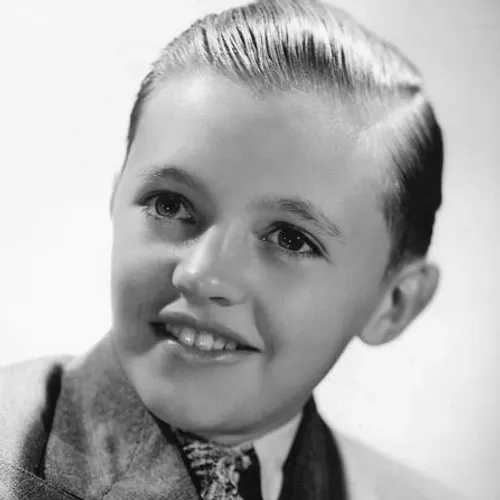
Terry Kilburn
Terry Kilburn remains one of the most memorable child actors of Hollywood's Golden Age, yet his career trajectory reveals a performer of remarkable depth and longevity. Born in the working-class neighborhoods of London and thrust into the glittering world of 1930s cinema at just eleven years old, Kilburn delivered performances that would etch themselves into film history. His portrayal of Tiny Tim in A Christmas Carol and his quadruple role in Goodbye, Mr. Chips showcased a rare combination of technical skill and emotional authenticity that captivated audiences. However, Kilburn's story extends far beyond his youthful stardom—it traces a thoughtful transition from the bright lights of Hollywood to the legitimate stage and ultimately to a distinguished career in theatrical direction that spanned nearly a quarter-century.
A London Childhood and the Journey West
Terence Edward Kilburn was born on November 25, 1926, in West Ham, Essex, to working-class parents Tom and Alice Kilburn. His father worked as a London bus driver, providing steady but modest income for the family. As a young child, Kilburn pursued unpaid acting work, performing in seaside concert parties where he delighted audiences with his impersonations of famous movie stars. When a talent agent recognized his potential, he encouraged the boy and his mother to pursue opportunities in Hollywood. In 1937, when Kilburn was just ten years old, he and his mother immigrated to the United States, with his father following the next year. The timing of his arrival proved fortuitous. A talent scout for Metro-Goldwyn-Mayer discovered Kilburn rehearsing for a radio show hosted by the legendary Eddie Cantor. This chance encounter led directly to his film debut and launched a career that would define an era of Hollywood filmmaking. The scout cast the young performer in Lord Jeff (1938), a British-set drama that introduced American audiences to the boy with the distinctive "innocent, dreamy, doe-eyed look" that would become his trademark.
The Golden Age of Child Stardom
Kilburn achieved fame almost overnight when he was cast as Tiny Tim in the 1938 MGM adaptation of A Christmas Carol at just eleven years old. His performance became iconic, culminating in one of cinema's most famous final lines: "God bless us, everyone." The role showcased not merely precocious talent but genuine emotional depth—a quality that distinguished him from many child performers of the era. The following year brought even greater recognition when Kilburn played four generations of the Colley family in Goodbye, Mr. Chips (1939). This demanding role required him to age from youth to adulthood within a single film, demonstrating remarkable range for such a young performer. The concluding line he delivered—"Goodbye, Mr. Chips"—would become equally legendary in cinema history. Between these two landmark films, Kilburn was featured in The Adventures of Sherlock Holmes (1939) alongside the distinguished Basil Rathbone. The early 1940s saw Kilburn working repeatedly with established stars, most notably Mickey Rooney. He appeared alongside Rooney in Andy Hardy Gets Spring Fever (1939), A Yank at Eton (1942), and National Velvet (1944). He also played leading roles in two films featuring Freddie Bartholomew: Lord Jeff and Swiss Family Robinson (1940). In 1946, he took the role of Joe, the horse's groom, in Black Beauty. The late 1940s brought a series of Bulldog Drummond films between 1947 and 1948, where he portrayed Seymour, a reporter. By 1950, as his childhood faded, Kilburn accepted smaller roles in various productions, signaling a natural transition away from leading parts.
The Pivot to Theatre and Education
After completing his high school education, Kilburn made a deliberate decision to shift his focus toward legitimate stage work rather than continue pursuing film roles. He enrolled at UCLA to study drama formally, seeking the training and foundation necessary for a serious theatrical career. This choice reflected maturity and artistic ambition—many child stars of his era struggled with the transition to adulthood on screen, but Kilburn chose to redirect his talents entirely. His Broadway debut came in 1952, when he was credited as Terrance Kilburn in a revival of George Bernard Shaw's Candida, where he portrayed Eugene Marchbanks. This performance marked his arrival as a serious stage actor, establishing credentials that would sustain his career for decades. After 1952, he was credited on screen as Terence Kilburn, reflecting both his matured identity and his shift away from film work. His final feature film role came in 1962 in Lolita, a small part that effectively concluded his cinema career. Between 1951 and 1969, however, he appeared in nearly a dozen teleplays, television movies, and television series episodes, maintaining a presence in dramatic media while primarily committing himself to theatre.
From Stage Actor to Artistic Director
The most significant chapter of Kilburn's professional life unfolded after his Hollywood years ended. From 1970 to 1994, he served as artistic director of Oakland University's Meadow Brook Theatre in Rochester, Michigan. This institution became the largest non-profit professional theatre in Michigan, presenting classic plays, comedies, and musicals to audiences throughout the region. Kilburn's tenure spanned twenty-four years, demonstrating a remarkable commitment to developing theatrical art and nurturing new talent. During his time at Meadow Brook Theatre, the institution became particularly renowned for its annual production of Charles Dickens' A Christmas Carol—adapted specifically by Charles Nolte, Kilburn's long-time partner. The circle thus completed itself: the child actor who had immortalized Tiny Tim returned to Dickens' masterpiece as an artistic leader, shaping how new generations would experience the beloved tale. This production became one of the theatre's defining offerings, underscoring Kilburn's deep connection to the material that had launched his career nearly a century before.
Legacy and Later Life
Kilburn's career demonstrates a rare trajectory among child actors—rather than fade into obscurity or struggle with the transition to adulthood, he deliberately reinvented himself, achieving sustained success across multiple theatrical disciplines. His work as artistic director proved as significant to American theatre as his youthful film performances had been to cinema. Since 1994, he has resided in Minneapolis, Minnesota. His partner of over fifty years, Charles Nolte—himself an accomplished actor, director, and playwright—passed away in January 2010. What remains remarkable about Kilburn's arc is its intentionality. He neither clung desperately to fading stardom nor abandoned performance entirely; instead, he evolved thoughtfully, moving from child actor to serious stage performer to theatrical visionary. His performances in A Christmas Carol and Goodbye, Mr. Chips remain touchstones of Golden Age Hollywood, yet his true legacy may ultimately rest in the decades he spent cultivating theatrical excellence at Meadow Brook, where countless performers learned their craft and audiences experienced the transformative power of live theatre.
Works and Appearances
Radio
- Eddie Cantor's radio show (1930s)
- Escape – "Roulette" (1950-10-13)
- Family Theater – "The Flame and the Sword" (1951-02-28)
- This Is Your FBI – "The Straw Hat Shakedown" (1951-05-18)
Cinema
- No Greater Glory (1934)
- Lord Jeff (1938)
- A Christmas Carol (1938)
- Sweethearts (1938)
- The Great Man Votes (1939)
Television
- Candida by George Bernard Shaw (1952)
- Various stage productions (1952–1970s)