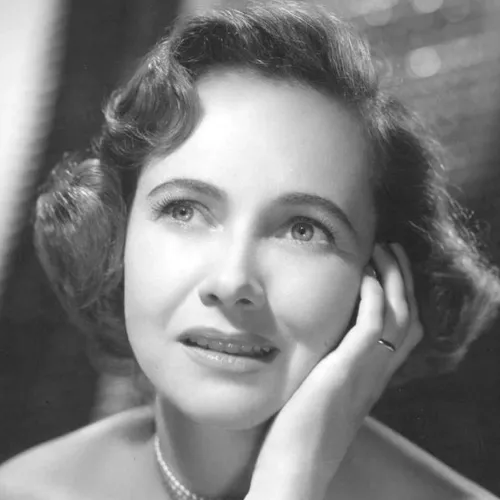
Teresa Wright
When Samuel Goldwyn discovered Teresa Wright backstage at the stage play Life with Father in 1939, he was witnessing the beginning of one of Hollywood's most remarkable trajectories. Yet Wright's brilliance extended far beyond the silver screen. Her venture into radio broadcasting demonstrated that her talent transcended medium—she could captivate audiences whether they were watching her in a darkened theater or listening to her voice crackle through the airwaves. Her radio work, particularly her acclaimed performances on Lux Radio Theater and The Screen Guild Theater, showcased an actress equally committed to bringing depth and authenticity to broadcast performances as she did to her celebrated film roles. Wright's radio career represents a fascinating chapter in the intersection of cinema and broadcasting, where major film stars lent their considerable talents to adapt their most famous works for the listening public.
Early Recognition and the Path to Broadcasting
Muriel Teresa Wright entered the entertainment world with an intensity that impressed even the most seasoned industry veterans. Born on October 27, 1918, in Harlem, New York City, she grew up in Maplewood, New Jersey, where her passion for acting solidified during high school years spent in Provincetown theater productions. Following her 1938 graduation, she moved to New York and understudied the role of Emily in Thornton Wilder's Our Town, eventually taking over the part when Martha Scott departed for Hollywood. Her Broadway breakthrough came in autumn 1939 when she joined the cast of Life with Father, playing Mary Skinner—a role she would maintain for two years. This stage work caught the attention of a talent scout working for producer Samuel Goldwyn, who envisioned Wright in the role of Bette Davis's daughter in the 1941 film adaptation of The Little Foxes. The discovery proved serendipitous. Wright's screen debut earned her a Best Supporting Actress Oscar nomination, making her one of the few actresses to receive a nomination for each of her first three films. Her rapid ascent in Hollywood coincided with the golden age of radio adaptations, when major studios saw broadcasting as both a promotional tool and an artistic medium worthy of their top talent. By the mid-1940s, radio had become an established venue for Wright and her peers to revisit their most celebrated film roles before millions of listeners.
Radio's Most Celebrated Film Adaptations
Wright's radio work centered on bringing her most acclaimed film performances to broadcast audiences. Her most significant radio appearance came on January 3, 1944, when she starred in the Lux Radio Theater adaptation of Shadow of a Doubt, reprising her role as Charlotte "Charlie" Newton. In the film version, directed by Alfred Hitchcock, Wright had played an innocent young woman who discovers that her beloved uncle, portrayed by Joseph Cotten, harbors a dark secret—he is a serial murderer. For the radio broadcast, Wright was paired with William Powell in the uncle role, representing a fascinating recasting that reflected radio's different approach to storytelling and available talent. The Lux Radio Theater program was among the most prestigious and popular radio venues of the era, featuring major Hollywood stars performing adaptations of contemporary films. Wright's participation in this broadcast demonstrated her standing in the industry and her willingness to engage with radio as a serious artistic medium rather than merely a promotional obligation. The performance allowed radio audiences nationwide to experience Wright's nuanced portrayal of a character torn between familial love and horrified discovery—a performance that Hitchcock himself had admired for its depth and authenticity. Beyond Lux Radio Theater, Wright expanded her radio presence through appearances on The Screen Guild Theater, another major program that featured Hollywood's elite in adaptations of their film work. These broadcasts represented more than mere repetition of already-filmed material; they offered actors the opportunity to refine their performances, respond to live audiences, and demonstrate their vocal and interpretive capabilities in a medium that demanded different skills than cinema.
The Actress's Commitment to Multiple Media
Wright's dedication to broadcasting reflected a broader professional philosophy that rejected the narrow studio system constraints that had defined Hollywood in earlier decades. By the mid-1940s, she had already begun her celebrated conflict with Samuel Goldwyn over her creative autonomy, which would culminate in a public dispute in December 1948. Her willingness to participate in radio adaptations during this period demonstrated that she viewed broadcasting as a legitimate artistic pursuit rather than simply a studio-mandated publicity vehicle. She approached radio roles with the same preparation and professionalism that earned praise from directors like Hitchcock and William Wyler, who called her "the most promising actress he had directed." The radio adaptations also positioned Wright within a larger ecosystem of entertainment that valued her particular talents. While her film career was anchored in dramatic roles that often explored moral complexity and psychological depth—qualities evident in The Best Years of Our Lives (1946) and The Men (1950)—her radio work allowed her to reach audiences who might not see theatrical releases or who preferred the intimate immediacy of broadcast performance. This multi-platform career strategy became increasingly important as Wright navigated the shifting landscape of American entertainment in the late 1940s and 1950s.
Legacy of Radio Performance and Artistic Integrity
Teresa Wright's radio appearances, though often overshadowed by her film accomplishments, represent an important dimension of her artistic legacy. Her choice to participate in radio broadcasts at a time when she was simultaneously challenging studio authority suggests that she viewed broadcasting as an opportunity for genuine artistic expression rather than a step backward from cinema. The quality of her radio work and her selection for prestigious programs like Lux Radio Theater reflected the industry's recognition of her talent and her status as a major star worthy of prime radio real estate. Wright's radio career illuminates a broader truth about the entertainment landscape of the 1940s: the most respected artists moved fluidly across media, bringing their considerable talents to whatever format offered the best opportunity for meaningful work. Her performances in radio adaptations of her films demonstrate that great acting transcends the specific technology through which audiences experience it. Whether viewers watched Wright's face register shock and betrayal in Hitchcock's Shadow of a Doubt or listened to her voice convey the same emotions through their radios, the fundamental artistry remained constant. This commitment to excellence across media contributed to Wright's enduring reputation as one of her generation's most accomplished and respected performers.
Works and Appearances
Radio
- Lux Radio Theater: Shadow of a Doubt (January 3, 1944)
- The Screen Guild Theater: Appeared in a broadcast on November 24, 1947
Cinema
- The Little Foxes (1941)
- The Pride of the Yankees (1942)
- Mrs. Miniver (1942)
- Shadow of a Doubt (1943)
- The Best Years of Our Lives (1946)
- The Men (1950)
- Enchantment (1948)
Television
- Playhouse 90 – The Miracle Worker (1957)
- NBC Sunday Showcase
- Alfred Hitchcock Hour (1964)
- Bonanza (1964)
- The Defenders (1964, 1965)
- CBS Playhouse (1969)
- The Love Boat – "A Christmas Presence" (December 18, 1982)
- Murder, She Wrote
- Dolphin Cove (1989)
- Picket Fences (1996)
Theater
- Our Town by Thornton Wilder (1938)
- Life with Father (1939–1941)
- Mary, Mary (1962)
- Tchin-Tchin (1963)
- The Locksmith (1965)
- Death of a Salesman (1975)
- Morning's at Seven (1980)


