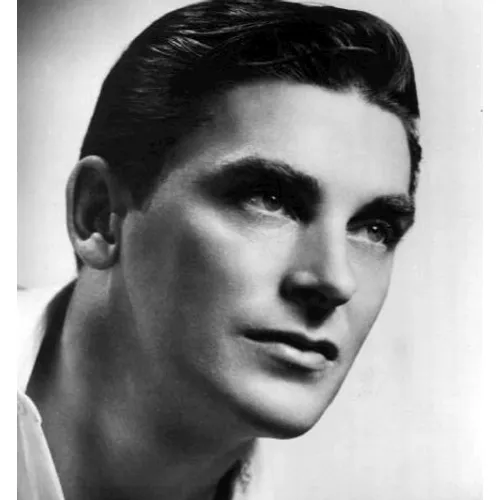
Richard Hart
Richard Hart was a talented American actor whose brief but vibrant career spanned radio, stage, television, and film during the 1940s. Despite his tragically short life, Hart made significant contributions to the performing arts, demonstrating remarkable versatility and potential that captivated audiences across multiple mediums.
Early Life and Theatrical Roots
Born on April 14, 1915, in Providence, Rhode Island, Richard Comstock Hart came from a distinguished family of lawyers. His lineage included his father Henry Clay Hart and grandfather Richard Borden Comstock, both prominent Rhode Island attorneys. Hart's early promise was evident during his education, where he became an all-American soccer player, hinting at the determination that would later characterize his artistic pursuits. Hart's journey into performance began somewhat serendipitously. While holidaying in a town with a summer theater, he heard they needed a male juvenile actor. Spontaneously auditioning and securing the role, Hart decided to pursue acting professionally. His initial steps included working as a journalist and gaining early experience with local theater groups like the Providence Players and Shoestring Players.
Breaking into Professional Performance
Hart's commitment to his craft led him to New York, where he studied at Tamara Daykarhanova's School for the Stage. His breakthrough came with a summer theater production where he played John, the witch boy, in a new play. The Shuberts recognized his talent and brought the production to Broadway, where Hart won a prestigious Theatre World Award for his debut performance. During this early period, Hart supplemented his income and gained experience by appearing in radio soap operas, a common pathway for emerging actors of his era. His versatility allowed him to quickly transition between different performance mediums, a skill that would define his short but impactful career.
Expanding into Film and Television
Hart's career expanded rapidly in the late 1940s. He made his film debut with MGM, appearing in movies like Green Dolphin Street (1947) and Desire Me (1947). His film roles showcased his ability to adapt to different genres and characters. Simultaneously, Hart was making significant strides in television. He appeared in numerous episodes of various programs, demonstrating his range as a performer. In a notable milestone, he became the first actor to play a specific television role in a series, though he was unable to complete the run due to his untimely death.
Personal Life and Tragic End
Hart's personal life was as complex as his professional journey. He was married twice - first to Eugenia Getchell, with whom he had a son, Christopher, and later to actress Louise Valery. He also had a son, Richard Lee Hart, born out of wedlock with Phyllis Eileen Buswell. Tragically, Richard Hart's promising career was cut short when he died of a heart attack on January 2, 1951, at the young age of 35. He passed away at French Hospital in New York City, leaving behind a legacy of potential unfulfilled.
Legacy and Impact
Though his career spanned less than a decade, Richard Hart demonstrated remarkable versatility as a performer. From radio soap operas to Broadway stages, from film to early television, he represented the dynamic entertainment landscape of mid-20th century America. His ability to transition between mediums and his early critical success suggested a career that might have become truly extraordinary.
Works and Appearances
Radio
- Various soap operas (1940s)
Stage
- Pillar to Post (1943-1944)
- Dark of the Moon (1945)
- Leaf and Bough (1949)
- Goodbye, My Fancy (1948-1949)
- The Happy Time (1950-1951)
Film
- Green Dolphin Street (1947)
- Desire Me (1947)
- B.F.'s Daughter (1948)
- Reign of Terror (1949)
Television
- Multiple episode appearances in various series (1950)
- First TV portrayal of a specific character in a series (1950)
Richard Hart's story is one of talent, potential, and a career tragically interrupted, leaving audiences to wonder what remarkable performances might have been.