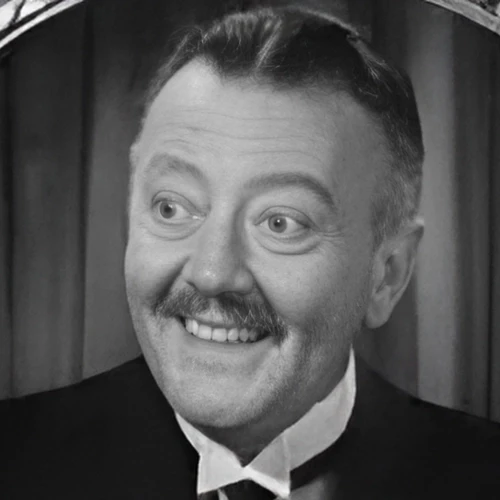
Raymond Walburn
Raymond Walburn, an American actor with a career spanning over five decades, became a familiar and beloved figure in entertainment. From his beginnings on the stage, Walburn transitioned to the silver screen, where his distinctive portrayal of pompous, blustering, and often comically inept characters left an indelible mark on dozens of movie comedies and occasional dramatic roles throughout the 1930s and 1940s. His unique style made him a memorable presence in the golden age of Hollywood and old-time radio.
Early Life and Theatrical Roots
Born on September 9, 1887, in Plymouth, Indiana, Raymond Walburn's path to acting began after high school when he moved to Oakland, California, with his mother, also an actress. He enrolled in an acting school associated with the Liberty Theatre, Oakland's leading stock company, where he cultivated his skills. His professional stage debut came at the age of 18, playing the Second Witch in Shakespeare's Macbeth. This early experience led to extensive touring in various stock shows, providing him with a broad foundation in theater. Walburn made his Broadway debut in 1912 with the successful production of The Greyhound. However, his burgeoning career was interrupted by military service during World War I, where he served in a heavy artillery corps in France from 1917 to 1918. This period of service occurred shortly after he had been cast in a juvenile lead role in The Brat, starring Maude Adams.
Crafting a Signature Persona on Stage and Screen
After his military discharge, Walburn quickly resumed his career on Broadway and in stock shows, steadily gaining recognition throughout the 1920s. A pivotal moment arrived in 1924 when he made his London debut as Aubrey Piper in The Show-Off. This role solidified his "pompous image and brash, phony-baloney facade," a trademark that would define his stage and later film performances. His "plus-sized comic vanity" became a reliable method for stealing scenes. While his stage career flourished, Walburn's initial ventures into film were sporadic. After a few minor silent film roles, he made a more significant appearance in 1929, supporting Ruth Chatterton in The Laughing Lady, where he played her unfaithful husband. He then returned to the stage, not making a substantial impact in cinema until 1934 with Broadway Bill, starring Warner Baxter. From this point, Walburn became a consistent presence in Hollywood, appearing in nearly 100 films, often cast as a stereotypical bumbler, a pompous snob, or occasionally a villain, such as Baron Danglars in The Count of Monte Cristo (1934).
A Master of Comedic Support
Raymond Walburn became a favored actor for renowned comedy directors like Frank Capra and Preston Sturges, appearing in several of their notable films. For Capra, he delivered memorable performances as Colonel Pettigrew, the racetrack tout, in Broadway Bill (1934), and as the ostentatious valet of Gary Cooper in Mr. Deeds Goes to Town (1936). He also played the opportunistic Judge Alexander in State of the Union (1948) and reprised his Colonel Pettigrew role in Capra's 1950 musical remake, Riding High, starring Bing Crosby. His collaborations with Preston Sturges further cemented his reputation for comedic excellence. Walburn was brilliant as the sarcastic Dr. Maxford in Christmas in July (1940), the windbag Mayor Noble in Hail the Conquering Hero (1944), and the boss who fires Harold Diddlebock in The Sin of Harold Diddlebock (1947), also known as Mad Wednesday. In the post-war years, Walburn, with his distinctive chunky frame, even headlined his own series of light comedy films, portraying patriarch Henry Latham in the "Henry" series, beginning with Henry, the Rainmaker (1949). He starred in five features of this series, often alongside Walter Catlett as Mayor Colton and Spring Byington as his wife, concluding with Father Takes the Air (1951).
Radio, Retirement, and Final Curtain Call
Beyond his extensive filmography, Raymond Walburn also contributed his talents to old-time radio. On April 24, 1939, he was among the actors featured in the Lux Radio Theatre episode titled "Broadway Bill". This radio adaptation, sponsored by Lux, presented a romance set in the world of horse racing, detailing a young man's sacrifice of wealth and career for his beloved thoroughbred. Walburn's participation in such a prominent radio program highlighted his versatility across different media during the golden age of broadcasting. Walburn's final film appearance was in the western The Gun That Won the West (1955). Following the death of his first wife, Gertrude Steinman, in 1953, he largely retired from acting, though he found personal happiness again by marrying family friend Jane Davis in 1955. In 1962, at the age of 74, he was persuaded by Zero Mostel to return to the stage in the burlesque musical farce A Funny Thing Happened on the Way to the Forum, playing a senile Roman citizen for 18 months. His final Broadway production was A Very Rich Woman in 1965, where he appeared alongside Helen Hayes. Raymond Walburn passed away in New York City on July 26, 1969, at the age of 81, after an extended illness.
Conclusion
Raymond Walburn's career was a remarkable journey through the evolving landscape of 20th-century entertainment. From his early days treading the boards to becoming a prolific and recognizable character actor in Hollywood and a voice on the radio, Walburn consistently brought a unique blend of pomposity and charm to his roles. His ability to inhabit and elevate supporting characters with his distinctive comedic timing ensured that he remained a sought-after talent. Walburn's legacy is that of a master character actor, whose memorable performances continue to entertain and remind us of the enduring power of a well-crafted persona.
Works and Appearances
Radio
- Lux Radio Theatre (April 24, 1939) – Actor in the episode "Broadway Bill"
Theater
- Macbeth (early 1900s) – Second Witch
- The Greyhound (1912) – Broadway debut
- The Brat (pre-1917) – Juvenile lead (replacement)
- The Show-Off (1924) – Aubrey Piper (London debut)
Cinema
- The Man Hunt (1916 short) – Captain Steadwell
- The Scarlet Runner (1916) – Saunders
- The Kiss of Iniquity (1916 serial) – John Brown
- Our Other Lives (1916 short)
- The Laughing Lady (1929) – Hector Lee
- The Great Flirtation (1934) – Henry Morgan