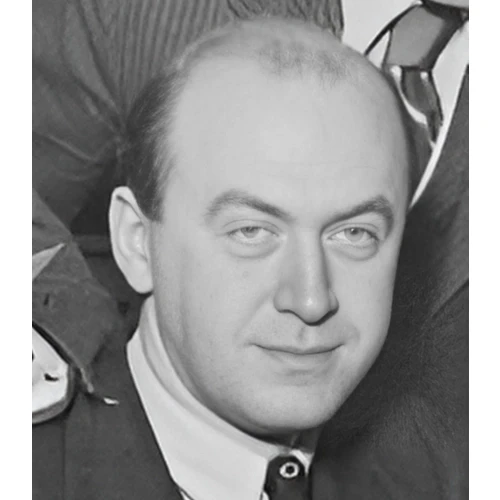
Otto Preminger
Otto Ludwig Preminger (5 December 1905 – 23 April 1986) was an Austro–Hungarian-American theatre and film director. After moving from the theatre to Hollywood, he directed over 35 feature films in a five-decade career. He rose to prominence for stylish film noirmysteries such as Laura (1944) and Fallen Angel (1945). In the 1950s and 1960s, he directed a number of high-profile adaptations of popular novels and stage works. Several of these pushed the boundaries of censorship by dealing with topics which were then taboo in Hollywood, such as drug addiction (The Man with the Golden Arm, 1955), rape (Anatomy of a Murder, 1959) and homosexuality (Advise & Consent, 1962). He was twice nominated for the Best Director Academy Award. He also had a few acting roles. Early life Preminger was born in 1905 in Wiznitz (Vyzhnytsia), a town west of Czernowitz, northern Bukovyna, in today's Ukraine, then part of the Austro–Hungarian Empire, into a Jewish family. His parents were Josefa (née Fraenkel) and Markus Preminger. Preminger's father was born in 1877 inGalicia, at a time when it was part of the Austro–Hungarian Empire. As an Attorney General of Austria–Hungary, Markus was a proud public prosecutor on the cusp of an extraordinary career defending the interests of the Emperor Franz Josef. The couple provided a stable home life for Preminger and his brother Ingo.
"My father believed that it was impossible to be too kind or too loving to a child. He never punished me. When there were problems he sat down and discussed them with me reasonably, as though I was an adult. I don't think my mother agreed completely with this method but she acted, as always, according to his wishes. I adored him. I had an affectionate relationship with my mother; she was a wonderful, warm-hearted woman, but she did not really play a large part in the formation of my character. Intellectually my father influenced me more than my mother."
After the assassination in 1914 of Archduke Franz Ferdinand, the heir to the throne, which led to the Great War, Russia entered the war on the Serbian side. Like other refugees in flight, Markus Preminger saw Austria as a safe haven for his family. He was able to secure a job as a public prosecutor in Graz, capital of the Austrian province of Styria. Preminger prosecuted nationalist Serbs and Croats who had been imprisoned as suspected enemies of the Empire. When the Preminger family relocated, Otto was nearly nine, and was enrolled in a school where instruction in Catholic dogma was mandatory and Jewish history and religion had no place on the syllabus. Ingo, not yet four, remained at home. After a year in Graz, the decisive public prosecutor was summoned to Vienna, where he was offered an eminent position, roughly equivalent to that of the United States Attorney General. Markus was told that the position would be his only if he converted to Catholicism. In a gesture of defiance and self-assertion, Markus refused. He received the position anyway. In 1915, Markus relocated his family to Vienna, the city that Otto later claimed to have been born in. Although now working for the emperor, Markus was a government official, respectable, but not part of the highly-prized inner city. As a result, the family started their new lives with rather modest quarters. Vienna was still an imperial capital with an array of cultural offerings that tempted Otto, at ten already incurably stagestruck. Career Theater Preminger's first theatrical ambition was to become an actor. In his early teens, Otto was able to recite from memory many of the great monologues from the international classic repertory, and, never shy, he demanded an audience. Preminger's most successful performance in the National Library rotunda was Mark Antony's funeral oration from Julius Caesar. As he read, watched, and after a fashion, began to produce plays, he started to miss more and more classes of school. Austria's failing fortunes during the war had no impact on the Premingers. Markus moved his family to a more fashionable district in 1916. As the war came to an end, Markus formed his own law practice. Markus instilled in both his sons a sense of fair play as well as respect for those with opposing view-points. As his father's practice continued to thrive in post-war Vienna, Otto began seriously contemplating a career in the theater. In 1923, when Preminger was seventeen, his soon-to-be mentor, Max Reinhardt, the renowned Viennese-born director who had established his base of operation in Berlin, announced plans to establish a theatrical company in Vienna in a rundown 135-year old theater. Reinhardt's announcement was seen as a call of destiny to Preminger. He began writing to Reinhardt weekly, requesting an audition. After a few months, Preminger, frustrated, gave up, and stopped his daily visit to the post office to check for a response. Unbeknownst to him, a letter was waiting with a date for an audition Preminger had already missed by two days. Feigning illness, Preminger skipped classes and began to hover near the stage door hoping to encounter Reinhardt associate Dr. Stefan Hock, begging for another audition. Preminger explained to his father that a career in theater was not just a ploy to excuse himself from school. This was a way of life, and it was the only one he wanted. In order to obtain his father's full blessing, Preminger finished school and completed the study of law at the University of Vienna. He juggled a commitment to the University and his new position as a Reinhardt apprentice. The two developed a mentor-and-protege relationship, becoming both a confidant and teacher. When the theater opened, on April 1, 1924, Preminger appeared as a furniture mover in Reinhardt's comedia staging of Carlo Goldoni's The Servant of Two Masters. His next, and more substantial appearance came late in the next month with William Dieterle (who would also later move to Hollywood) in The Merchant of Venice. Other notable alumni who Preminger would work with the same year were Mady Christians, who committed suicide after having been blacklisted during the McCarthy era in Hollywood, and Nora Gregor, who was to star in Jean Renoir's La Règle du jeu (1939). Reinhardt may have had reservations about Preminger's acting but he quickly detected the young man's abilities as an administrator. He appointed Preminger as an assistant in the Reinhardt acting school that opened in the theater at Schönbrunn, the former summer palace of the emperor. The following summer, a frustrated Preminger was no longer content to occupy the place of a subordinate and he decided to leave the Reinhardt fold. His status as a Reinhardt muse gave him an edge over much of his competition when it came to joining German-speaking theater. His first theater assignments as a director in Aussig were plays ranging from the sexually provocative Lulu, and from Berlin he imported Roar China, a pro-Communist agitprop. Preminger displayed pleasure in discovering new talent, but also created pitfalls with his unruly temper and disdain for directorial collaborations. In 1930, a wealthy industrialist from Graz approached the rising young theater director with an offer to direct a film called Die große Liebe (The Great Love). Preminger did not have the same passion for the medium as he had for theater. He accepted the assignment nonetheless. The film premiered at the Emperor Theater in Vienna on 21 December 1931, to strong reviews and business. From 1931-1935, Preminger directed twenty-six shows. Among the performers he hired were Lili Darvas, Lilia Skala, Harry Horner, Oskar Karlweis, Albert Bassermann, and Luise Rainer, who was to win back-to-back Academy Awards in 1936 and 1937. It was not until t
