Michael Dunn
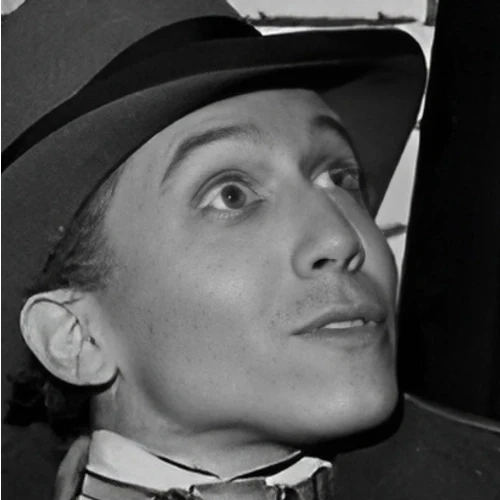
Michael Dunn (October 20, 1934 – August 30, 1973) was an American actor and singer who shunned the usual "cute" typecasting of dwarf actors and sought serious roles requiring dramatic skill. He was a trailblazer who ultimately inspired a generation of dedicated actors with extreme short stature, including Zelda Rubinstein, Mark Povinelli, and Ricardo Gil. Medical condition Michael Dunn suffered from medical dwarfism, a result of spondyloepiphyseal dysplasia (SED, subtype unknown), a genetic defect of cartilage production caused by a mutation in the COL2A1 (type II collagen) gene. This disorder, classified as a skeletal dysplasia, caused distorted development of his limbs, spine, and ribcage and led to early, widespread osteoarthritis and constricted lung growth. As an adult, he stood 3' 10" and weighed about 78 pounds (117 cm, 35 kg). During Dunn's lifetime, his condition was described by the nonspecific term "progressive chondrodystrophy," or alternatively as "achondroplasia", a term that now refers specifically to a skeletal dysplasia caused by a defect in the gene for fibroblast growth factor receptor 3. Early life He was born as Gary Neil Miller to Jewell Miller (née Hilly) and Fred B. Miller of Fargo, Oklahoma and Shattuck, Oklahoma, during the time of theDust Bowl drought. He chose his stage name in order to differentiate himself from another Gary Miller in Screen Actors Guild. ("Dunn" was his maternal grandmother's maiden name, but his reason for choosing "Michael" is unknown and not derived from his monastic experience in 1958.) He was an only child. When he was four, his family moved to Dearborn, Michigan. Dunn was gifted intellectually and musically. He started reading at age three, was champion of the 1947 Detroit News Spelling Bee—representing Wallaceville School in Wayne County—and showed early skill at the piano. He enjoyed singing from childhood, loved to draw an impromptu audience (even while waiting for a bus), and developed a pleasing lyric baritone and superb sight-reading skills. His parents defied pressure from school authorities to sequester him in a school for disabled children and staunchly supported his talents, independence, and integration into mainstream society. "I always got thrown out of classes for being too lippy", he commented about his experience with elementary school teachers. "I'd read more than they." His orthopedic condition greatly limited his mobility, but he swam and ice skated in childhood and remained a skilled swimmer throughout his life. Education He attended Redford High School in Detroit (1947–1951), then entered University of Michigan in Ann Arbor in September, 1951, just before his 17th birthday. However, according to his Columbia Studios press kit biography, his studies were interrupted when he was knocked down a flight of stairs during a "student rush," which resulted in a three-month hospital stay. In 1953, he transferred to the University of Miami, College of Arts and Sciences, which offered a better climate and more accessible campus. His transcript shows that, despite scoring at the 97th percentile of ACE placement exams and the 99th percentile of the CTS English test, he did not distinguish himself academically. However, he was a high spirited and well-known figure about campus who sang in the talent show and facetiously joined the football cheerleading squad. Archives at that university's Otto G. Richter Library show that he became first a copyeditor and a contributing writer, then managing editor in 1954 of the college magazine, Tempo. (Contrary to information that later appeared in his Columbia Studios biography, Dunn could not take credit forTempo winning the Sigma Delta Chi Award for best college magazine in the country, since credit went to the Editor-in-Chief.) His classmate John Softness recalled, "He could sing like an angel, and he could act and he could write and he was a brilliant raconteur." Softness ran a campus-wide advertising campaign called "Wheels for Gary," which brought in enough money from student donations to buy a used 1951 Austin outfitted with hand controls, so that Dunn could get around independently. At various points, he held different odd jobs—singing in a nightclub, answering telephones for the Miami Daily News, and working as a hotel detective. ("What a gaff! I got my room free and all I did was play cards with the night clerk and keep an eye open for any funny business in the lobby. Who would ever suspect me of being a detective?") He left college in 1956 after completing only his sophomore year, returned to Michigan, and attended summer classes at the University of Detroit, in 1957. Religion Dunn had converted to Catholicism (probably from Methodism-Episcopalianism, judging by his parents' marriage certificate) and was baptized on September 25, 1954, by Rev. J. M. O'Sullivan at Church of the Little Flower in Coral Gables, Florida. He was living in Ann Arbor with his parents, working as a professional singer, at the time he entered St. Bonaventure Monastery in Detroit, on February 25, 1958. According to a Capuchin Provincial Archivist, Dunn entered with the intention of becoming a Capuchin non-ordained Brother. He was known by his given name, Gary, since he never became a novice. A testimonial from John F. Bradley, Catholic Chaplain, University of Michigan, states: "He has always been interested in Catholic activities and was president of the Newman Club in another school." In response to a question on the monastery application asking: "How long have you been thinking of entering religious life?" Dunn wrote, "More than three years." Dunn was later quoted in the New York Post explaining that he had wanted to be of service, since he was unfit for the military: "Everyone my age was going to Korea and I had this feeling that singing wasn't exactly doing my part." However, monastery records entered by the Master of Novices show that the physical demands of monastic life in a huge, 19th-century building with no elevator proved too strenuous. Dunn left of his own accord on May 8, 1958, in order to pursue a stage career in New York. Career In New York, Dunn re-encountered Softness, who volunteered to be his manager. He also befriended actress Phoebe Dorin in an off Broadway show, "Two by Saroyan," in which both had small parts in the early 1960s. They began singing together casually after their nighttime performances, sitting on the wall of the fountain opposite the Plaza Hotel, and drew a following. Eventually, on the advice of fellow actor Roddy McDowall, the pair started a nightclub act of songs mixed with conversational patter, titled "Michael Dunn and Phoebe." The act received favorable reviews in Timemagazine and The New York Times and ultimately led directly to the pair being cast on The Wild Wild West television series, a Western spy spoof with elements of historical fiction and science fiction, which debuted in 1965. Dunn was probably best known for his recurring role on that series as Dr. Miguelito Loveless (Miguelito is Spanish for "Little Michael"), a mad scientist who devised passionately perverse schemes and gadgetry to ensnare Secret Service agents James West and Artemus Gordon (Robert Conrad and Ross Martin). Dorin played Dr. Loveless's devoted assistant, Antoinette. In each episode in which they appeared together, the villainous couple tenderly sang a Victorian duet or two, heedless of the mayhem they had created around themselves. According to Dorin, Dunn saved her from drowning during filming of the episode, The Night of the Murderous Spring, plunging underwater to tear her free, when her costume became entangled in machinery used to sink a boat on the set.