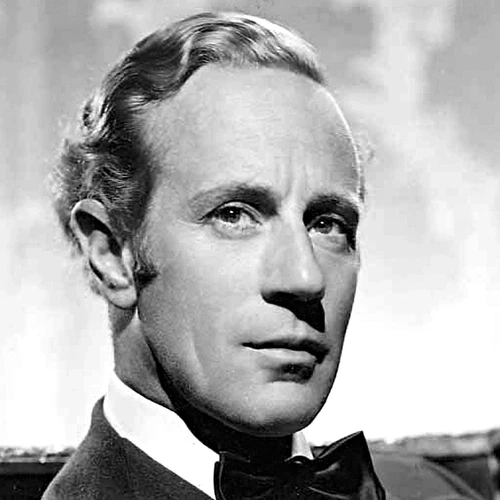
Leslie Howard
An English stage and film actor, director, and producer. Among his best-known roles was Ashley Wilkes in Gone with the Wind (1939) and roles in Berkeley Square (1933), Of Human Bondage (1934), The Scarlet Pimpernel (1934), The Petrified Forest (1936), Pygmalion (1938), Intermezzo (1939), "Pimpernel" Smith (1941) and The First of the Few (1942).
Leslie Howard was far more than just a celebrated actor of stage and screen—he was a pioneering radio performer who captivated audiences across multiple media platforms during the 1930s and early 1940s. His distinctive voice and dramatic talents made him a sought-after radio personality during the medium's golden era.
Early Life and Radio Beginnings
Leslie Howard Steiner emerged into the world of entertainment with a multifaceted talent that would define his career. Born on April 3, 1893, in London, Howard began his radio journey in the early 1930s, initially performing dramatic readings for The Yardley Program . Though many of these early recordings have been lost, fan magazines and contemporary radio guides documented his emerging radio presence . Howard's radio work was not merely a side pursuit but a significant aspect of his artistic expression. He appeared on numerous popular radio shows, including The Rudy Vallee Show/Fleischmann's Yeast Hour, where he even performed alongside his 10-year-old daughter, Leslie Ruth Howard, in a memorable performance from a scene in The Enchanted Forest . The performance was so well-received that it prompted an unprecedented encore, a rare occurrence in the show's history.
Wartime Broadcasting and Propaganda Efforts
As World War II escalated, Howard's radio work took on a more serious and patriotic tone. He became a crucial voice in broadcasting propaganda and rallying support for the Allied cause. His Britain Speaks broadcasts, transmitted to the United States from July 1940, were particularly significant. These programs urgently encouraged American support for Britain, with Howard completing 27 broadcasts by January 1941 . Howard's radio appearances during this period were not just entertainment but strategic communication. He participated in the Radio Tribute to the King and Queen, where numerous British stars performed while the royal family listened. His commitment to using media as a tool for international solidarity was evident in every broadcast .
Signature Style and Performance Techniques
What distinguished Howard in radio was his theatrical background. As an accomplished stage and film actor, he brought a dramatic flair to his radio performances that set him apart from other broadcasters. His ability to convey emotion and narrative through voice alone made his radio appearances compelling and memorable. Howard was versatile, appearing on panel programs like Brain Trust and performing in various dramatic readings and adaptations. His radio work complemented his acting career, allowing him to reach audiences in a more intimate, immediate medium .
Legacy and Impact on Radio Broadcasting
Though most of Howard's radio broadcasts have been lost to time, the few surviving recordings and contemporary accounts reveal his significant contribution to radio entertainment and wartime communication. He represented a generation of performers who seamlessly transitioned between stage, screen, and radio, helping to establish radio as a serious artistic and informational medium. Tragically, Howard's promising radio career was cut short when he was killed in 1943 during a transatlantic flight, reportedly shot down by German forces. His death was a significant loss not just to entertainment, but to the propaganda and communication efforts of the Allied forces .
Conclusion
Leslie Howard was more than an actor—he was a multimedia artist who understood the power of voice and performance. His radio work, though often overshadowed by his film career, was a crucial part of his artistic legacy, bridging entertainment, information, and wartime communication.
Works and Appearances
Radio
- The Yardley Program (Early 1930s)
- The Rudy Vallee Show/Fleischmann's Yeast Hour (1935)
- Britain Speaks (1940-1941)
- Radio Tribute to the King and Queen (Wartime)
- Brain Trust (Various years)
Film
- The Scarlet Pimpernel (1934)
- Pygmalion (1938)
- Gone with the Wind (1939)
Stage
- The Petrified Forest (Broadway, 1935)
- Berkeley Square (Broadway)
- Murray Hill (1927)
Publications
- Trivial Fond Records (Posthumous collection of writings, 1982)