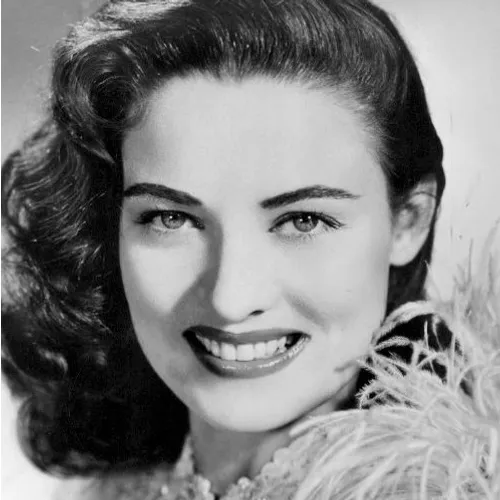
Julie Wilson
Julie Wilson was a remarkable American performer whose career spanned multiple entertainment mediums, though she was most renowned for her extraordinary cabaret performances. Her journey from a small-town girl in Omaha, Nebraska, to becoming a celebrated singer and actress epitomizes the quintessential mid-20th-century entertainment success story.
Early Life and Artistic Beginnings
Born Julie May Wilson on October 21, 1924, in Omaha, Nebraska, she emerged from humble beginnings. Her parents, Emily Wilson, a hairdresser, and Russell Wilson, a coal salesman, provided a modest but supportive environment for her budding talents. In her teenage years, Wilson discovered her musical passion by performing with a local musical group called "Hank's Hepcats". Her early promise was evident when she won a local beauty pageant, narrowly missing the opportunity to compete in a larger competition due to being just under the required minimum age of 18. During World War II, Wilson made the bold decision to head to New York City, a move that would define her professional trajectory. She quickly found work in two of Manhattan's most prestigious nightclubs, establishing her initial foothold in the entertainment world. Her talent caught the attention of influential gossip columnist Hedda Hopper, who referred to Wilson as a "discovery" and noted she was being tested by significant entertainment entities.
Broadway and Stage Career
Wilson's stage career blossomed rapidly. She made her Broadway debut in Three to Make Ready in 1946. In 1951, she expanded her horizons by moving to London, where she starred in theatrical productions and studied at a prestigious performing arts institution. Over the next four years, she appeared in various shows and continued to refine her craft. Her Broadway credits became increasingly impressive, including notable productions like Legs Diamond (1954), Baker Street (1965), Park (1970), and Legs Diamond (1988). Her performance in the latter earned her a Tony Award nomination for Best Featured Actress in a Musical. Wilson's versatility allowed her to tour in numerous productions, demonstrating her wide-ranging theatrical talents.
Film and Television Ventures
Beyond the stage, Wilson made significant inroads in film and television. In 1957, she sang with Hal McIntyre and his Orchestra, contributing vocals to a film soundtrack and even securing an acting role as singer Ivy Corlane. Her television work included regular roles in American daytime programming and appearances in various telecasts, including a notable performance in Kiss Me, Kate.
Personal Life and Cabaret Legacy
Wilson's personal life was as dynamic as her professional career. She was married three times, including to talent agent Barron Reynolds Polan and film producer Michael McAloney, with whom she had two sons, Holt and Michael Jr.. In 1983, after her children were grown, Wilson found her true calling in cabaret performance, becoming renowned for her dramatic delivery of standards and show tunes. Often referred to as "the queen of cabaret", Wilson's reputation in this intimate performance genre was unparalleled. Her ability to interpret songs with profound emotional depth made her a legendary figure in the cabaret world.
Legacy and Final Years
Julie Wilson's remarkable career came to a close on April 5, 2015, when she passed away in New York City at the age of 90, following a stroke. She left behind a legacy as a versatile performer who had made significant contributions to Broadway, film, television, and most notably, cabaret.
Works and Appearances
Theater
- Three to Make Ready (1946)
- Legs Diamond (1954)
- Baker Street (1965)
- Park (1970)
- Legs Diamond (1988)
Film
- Unnamed film with Hal McIntyre Orchestra (1957)
- Legs Diamond (acting role)
Television
- Various daytime program roles
- Kiss Me, Kate telecast
- Multiple episodic appearances
Cabaret
- Prominent cabaret performer from 1983 until her retirement
Julie Wilson's multifaceted career serves as a testament to her extraordinary talent and adaptability in the entertainment world of the mid-20th century.