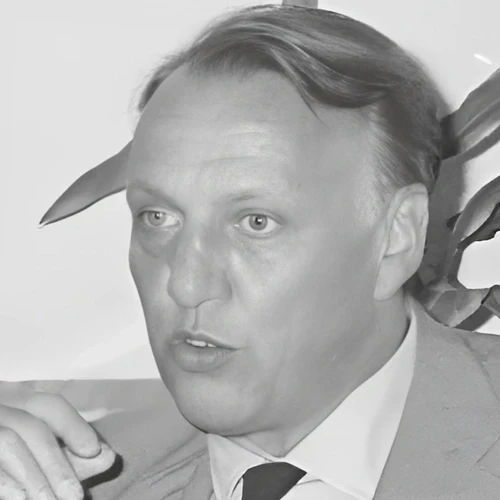
Joseph Losey
Joseph Walton Losey (January 14, 1909 – June 22, 1984) was an American theater and film director. After studying in Germany with Bertolt Brecht, Losey returned to the United States, eventually making his way to Hollywood. In the 1950s Losey was blacklisted in the United States and moved to Europe where he made the remainder of his films, mostly in the United Kingdom.
Early life and career Joseph Losey was born on January 14, 1909, in La Crosse, Wisconsin, where he was friends with Nicholas Ray in high school. He attended Dartmouth and Harvard, beginning as a student of medicine and ending in drama. Losey became a major figure in New York political theatre, first directing the controversial failure Little Old Boy in 1933. He declined to direct a staged version of Dodsworth by Sinclair Lewis, which led Lewis to offer him his first work written for the stage, Jayhawker. Losey directed the show, which had a brief run. Bosley Crowther in the New York Times noted that "The play, being increasingly wordy, presents staging problems that Joe Losey's direction does not always solve. It is hard to tell who is responsible for the obscure parts in the story." In 1935, he visited the Soviet Union for several months to study the Russian stage. He either accompanied or was accompanied by Elizabeth Hawes, who staged a show of her fashions in Moscow. In 1936, he directed Triple-A Plowed Under on Broadway, part of the WPA's Federal Theatre Project. Losey married Hawes on July 24, 1937. They had a son, Gavrik Losey, in 1938. They divorced in November 1944. He arrived in Hollywood just after the Second World War. His first film, in 1947, was a political allegory The Boy with Green Hair. That same year he returned to Broadway and staged the first English language version of Bertolt Brecht's Galileo starring Charles Laughton, with music by Hanns Eisler. Of the extravagant production with 66 roles, Brooks Atkinson wrote: "As produced under Joseph Losey's direction, Mr. Brecht's play diffuses the legend of Galileo across the stage, and values showmanship above the drama." Participants reported that Laughton and Brecht controlled the performance, leaving little for Losey in the role of director. Politics and exile The House Un-American Activities Committee (HUAC) was interested in Losey because in the 1930s and 40s he had extensive contacts with people on the political left, including radicals and Communists or people who would become such. He had a long association with Hanns Eisler, long a target of HUAC's interest. Losey wrote to the Immigration and Naturalization Service in support of a resident's visa for the composer, who had many radical associations. They collaborated on a "political cabaret" from 1937 to 1939. Losey invited him to compose music for a short public relations film he had been commissioned to direct for presentation at the 1939 New York World's Fair, Petre Oleum and His Cousins, which launched Eisler's career in film music. Losey had also worked on the Federal Theater Project, long a target of HUAC. Triple-A Plowed Under, on which Losey had worked, had been denounced by HUAC's antecedent, the Dies Committee as Communist propaganda. His Hollywood collaborators included a long list of other HUAC targets, including Dalton Trumbo and Ring Lardner. Losey's first wife Elizabeth Hawes worked with wide range of Communists and anti-Communist liberals at the radical newspaper PM during their marriage. After it ended in 1944, she wrote about working as a union organizer just after World War II, where "one preferred the Communists to the Red-Baiters". At some point, probably early in the 1940s, the FBI was maintaining dossiers on both Losey and Hawes. His included charges that he was a Stalinist agent as of 1945. In 1946, Losey joined the Communist Party. He later explained to a French interviewer:
I had a feeling that I was being useless in Hollywood, that I'd been cut off from New York activity and I felt that my existence was unjustified. It was a kind of Hollywood guilt that led me into that kind of commitment. And I think that the work that I did on a much freer, more personal and independent basis for the political left in New York, before going to Hollywood, was much more valuable socially.
Losey had a long-term contract with Dore Schary at RKO when Howard Hughes purchased the company in 1948 and began purging