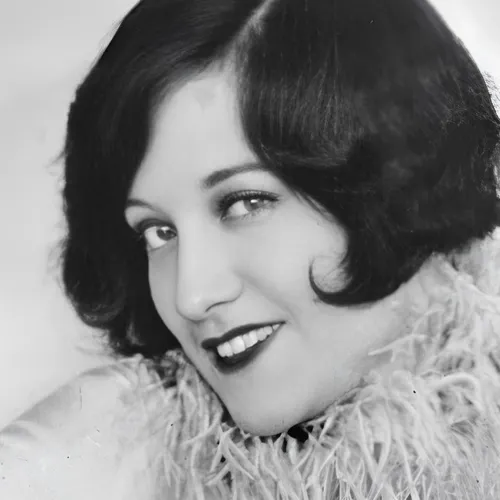
Joan Crawford
Joan Crawford (March 23, ca. 1904 – May 10, 1977), born Lucille Fay LeSueur, was an American actress in film, television and theatre. Starting as a dancer in traveling theatrical companies before debuting as a chorine on Broadway, Crawford was signed to a motion picture contract by Metro-Goldwyn-Mayer in 1925. Initially frustrated by the size and quality of her parts, Crawford began a campaign of self-publicity and became nationally known as a flapper by the end of the 1920s. In the 1930s, Crawford's fame rivaled, and later outlasted, MGM colleagues Norma Shearer and Greta Garbo. Crawford often played hardworking young women who find romance and success. These "rags-to-riches" stories were well received by Depression-era audiences and were popular with women. Crawford became one of Hollywood's most prominent movie stars and one of the highest paid women in the United States, but her films began losing money and by the end of the 1930s she was labeled "Box Office Poison". Two years later, she staged her comeback by starring in Mildred Pierce (1945), for which she won the Academy Award for Best Actress. In 1955, she became involved with the Pepsi-Cola Company through her marriage to company Chairman Alfred Steele. After his death in 1959, Crawford was elected to fill his vacancy on the board of directors but was forcibly retired in 1973. She continued acting in film and television regularly through the 1960s, when her performances became fewer; after the release of the British horror film Trog in 1970, Crawford retired from the screen. Following a public appearance in 1974, after which unflattering photographs were published, Crawford withdrew from public life and became increasingly reclusive until her death in 1977. Crawford married four times. Her first three marriages ended in divorce; the last ended with the death of husband Alfred Steele. She adopted five children, one of whom was reclaimed by his birth mother. Crawford's relationships with her two older children, Christinaand Christopher, were acrimonious. Crawford disinherited the two and, after Crawford's death, Christina wrote a "tell-all" memoir,Mommie Dearest, in which she alleged a lifelong pattern of physical and emotional abuse perpetrated by Crawford. Joan Crawford was voted the tenth greatest female star in the history of American cinema by the American Film Institute.
Early life Crawford was born Lucille Fay LeSueur in San Antonio, Texas, the third child of Thomas E. LeSueur (January 21, 1868–January 1, 1938), a laundry laborer of English and French Huguenot ancestry and Anna Bell Johnson (November 29, 1884 ?? – August 15, 1958),Texas-born, of Swedish and Irish descent. Her elder siblings were Daisy (ƒ 1902), who died before Lucille's birth, and Hal LeSueur. Thomas LeSueur abandoned the family a few months before Crawford's birth but reappeared in Abilene, Texas in 1930 as a 62-year-old construction laborer on the George R. Davis House, built in Prairie School architecture. Crawford's mother subsequently married Henry J. Cassin (born c. 1867–died October 25, 1922; this marriage is listed in census records as Crawford's mother's first marriage, calling into question whether Thomas LeSueur and Anna Bell Johnson were ever legally wed.) The family lived in Lawton, Oklahoma, where Cassin, a minor empresario, ran the Ramsey Opera House. Cassin had presented performers as diverse as Anna Pavlova and Eva Tanguay during his career. Crawford was unaware that Cassin, whom she called "Daddy", was not her biological father until her brother Hal told her. Lucille preferred the nickname "Billie" as a child and she loved watching vaudeville acts perform on the stage of her stepfather's theatre. The instability of her family life affected her education and her level of schooling never really progressed beyond the fourth grade. Her ambition was to be a dancer. However, in an attempt to escape piano lessons to play with friends, she leaped from the front porch of her home and cut her foot deeply on a broken milk bottle. She had three operations and was unable to attend elementary school for 18 months. She eventually fully recovered and returned to dancing. Cassin was accused of embezzlement and although acquitted in court, was blacklisted in Lawton, and the family moved to Kansas City, Missouri around 1916. Cassin was first listed in the City Directory in 1917, living at 403 East Ninth Street. A Catholic, Cassin placed Crawford at St. Agnes Academy in Kansas City. Later, after her mother and stepfather broke up, she stayed on at St. Agnes as a work student. She then went to Rockingham Academy, also as a work student. She later claimed the headmaster's wife there beat her and forged her grades to hide the fact that young Lucille spent far more time working, primarily cooking and cleaning, rather than being able to study academically. While attending Rockingham she began dating and had her first serious relationship, with a trumpet player named Ray Sterling, who reportedly inspired her to begin challenging herself academically. In 1922, she registered at Stephens College in Columbia, Missouri, giving her year of birth as 1906. She attended Stephens for only four months before withdrawing after she realized she was not prepared for college. Career Early career
Joan Crawford in 1928
Under the name Lucille LeSueur, Crawford began dancing in the choruses of traveling revues and was spotted dancing in Detroit by producerJacob J. Shubert. Shubert put her in the chorus line for his 1924 show, Innocent Eyes, at the Winter Garden Theatre on Broadway in New York City. While appearing in Innocent Eyes Crawford met a saxophone player named James Welton. The two were allegedly married in 1924 and lived together for several months, although this supposed marriage was never mentioned in later life by Crawford. She wanted additional work and approached Loews Theaters publicist Nils Granlund. Granlund secured a position for her with producer Harry Richmond's act and arranged for her to do a screen test which he sent to producer Harry Rapf in Hollywood. Stories have persisted that Crawford further supplemented her income by appearing in one or more stag, or soft-core pornographic, films, although this has been disputed. Rapf notified Granlund on December 24, 1924 that Metro-Goldwyn-Mayer had offered Crawford a contract at $75 a week. Granlund immediately wired LeSueur – who had returned to her mother's home in Kansas City – with the news; she borrowed $400 for travel expenses. She departed Kansas City on December 26 and arrived in Culver City, California on January 1, 1925. As Lucille LeSueur, her first film was The Circle in 1925, followed by Pretty Ladies, starring ZaSu Pitts. That same year, she appeared in small roles in the films The Only Thing and Old Clothes. MGM publicity head Pete Smith recognized her ability but felt that her name sounded fake; it also, he told studio head Louis B. Mayer, sounded like "Le Sewer". Smith organized a contest in conjunction with the fan magazine Movie Weekly to allow readers to select her new name. Initially, the name "Joan Arden" was selected but, when another actress was found to have prior claim to that name, the alternate name "Crawford" became the choice. Crawford initially wanted her new first name to be pronounced "Jo-anne". She hated the name Crawford, saying it sounded like "crawfish". Her friend, actor William Haines, quipped, "They might have called you 'Cranberry' and served you every Thanksgiving with the turkey!" Crawford continued to dislike the name throughout her life but, she said, she "liked the security that went with it". <span class="mw-headline" id="Self-prom
Heard in