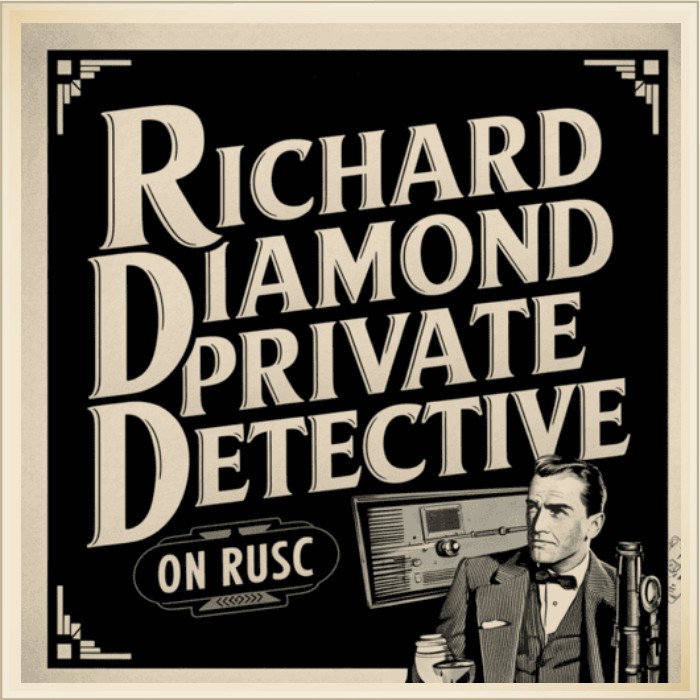
Our members have consistently praised it for its tight plotting, sparkling banter, and that unmistakable Dick Powell swagger—and I’m delighted to say we’ve got 20 more episodes lined up to add to RUSC.
Debuting on radio in 1949 and running through 1953 across NBC and ABC, Richard Diamond came at just the right moment in Dick Powell’s career. Having reinvented himself on screen from cheerful crooner to noir leading man in the 1940s, Powell brought both sides of that persona to radio: the crisp, sardonic private eye who can navigate a dark alley at midnight and the smooth vocalist who can close an episode with a tune at the piano. That blend is the show’s signature—equal parts steel and silk.
The premise is familiar to fans of postwar detective radio: Diamond is an ex-cop turned private investigator, plying his trade in New York City. But the execution is distinctly its own. The cases are well-constructed, with stakes that feel real and villains who don’t twirl mustaches so much as make very human mistakes—greed, jealousy, fear. Yet just when the tension threatens to get too grim, the show leans into wit. Diamond’s quips aren’t throwaways; they’re part of his armor. He uses humor the way great detectives use a magnifying glass—probing, deflecting, and putting people at ease until they say something they shouldn’t.
Powell’s supporting cast is a big part of why the series hums. Virginia Gregg’s Helen Asher, the wealthy and warmly witty girlfriend, offers a soft landing after Diamond’s rough days. Their scenes add warmth and rhythm—often literally when Powell slips into a song at Helen’s piano to send listeners off with a smile. Ed Begley brings authority and exasperated affection as Lieutenant Walt Levinson, the ever-patient NYPD foil who knows Diamond’s good for results, if not for punctual paperwork. And in one of those wonderful feats of radio versatility, Wilms Herbert turns up both as the gruff, put-upon Sergeant Otis and as Francis, Helen’s impeccable, drolly amused butler. That dual performance gives the show a comic undertow without ever breaking its noir mood.
Behind the scenes, Richard Diamond benefited from sharp writing and an ear for character. Blake Edwards—who would go on to create Peter Gunn for television—contributed scripts and helped shape the series’ breezy, modern feel. You can sense in Diamond the first stirrings of the jazzier, more urbane detective style that the late 1950s would embrace, but here it’s anchored in classic radio craft: crisp narration, evocative soundscapes of Manhattan’s streets and nightclubs, and plots that play fair with the listener.
For longtime RUSC members, one special pleasure is how the show moves confidently between tones. A given episode might open with a body in a tenement, swerve through a Fifth Avenue drawing room, and end, after justice is served, with Diamond crooning a standard—just enough light to remind you that life in this city still has its grace notes. That closing song was no gimmick; it’s part of what made the series so distinct in a crowded field of gumshoes. Where Sam Spade bristled and Philip Marlowe brooded, Richard Diamond flirted, wisecracked, and serenaded—without ever losing his edge.
The series’ popularity on radio even paved the way for a television incarnation in the late 1950s starring David Janssen. While the TV version had its own flavor and is worth a look for curiosity’s sake, it’s on radio that Diamond truly shines. The intimacy of Powell’s voice, the economy of the scripts, and the way the imagination fills in the smoky rooms and rainy sidewalks—this is prime radio detective storytelling.
A quick listening tip for newcomers: don’t worry about strict order. Richard Diamond is easy to drop into anywhere. If you enjoy the brisk, wisecracking feel, try episodes from the early run first—the production is lively, and Powell’s musical codas are frequent. If you prefer a touch more grit, some of the later entries lean slightly darker, while keeping the show’s trademark sparkle. Audio quality will vary, as with all surviving radio, but even the rougher transfers reward a little patience; the performances are too good to miss.
It’s no surprise to me that our RUSC members consistently give Richard Diamond top marks. The show is endlessly re-listenable, the kind of series you can return to for the rhythms of its dialogue as much as for the mystery puzzle. And the good news is, there’s more on the way: I’ll be adding 20 additional episodes to the library, so if Diamond’s been on your favorites list—or if you’ve been meaning to give him a try—now’s the perfect time.
Once you’ve sampled the new additions. be sure to leave a review or comment underneath. Which cases hooked you? Did a particular closing song stick in your head? Richard Diamond proves, episode after episode, that style and substance can share the same trench coat—and that’s why he remains one of radio’s most appealing private eyes.